What Is Credential Stuffing? How to Detect and Prevent?
Learn what credential stuffing is, how it happens, and the practical steps to detect and prevent attacks on both personal and business accounts safely.

Do you use the same password for more than one online account?
If yes, you could be an easy target for credential stuffing, a silent cyberattack that can steal your data in seconds. Your email, banking accounts, or even business accounts could be at risk if you reuse passwords.
Studies show that over 60% of people reuse passwords across different accounts, making them easy targets.
By understanding credential stuffing, learning how to detect it, and following simple prevention steps, you can protect your accounts and stay safe online.
Disney+ Account Takeover
When Disney+ launched in 2019, thousands of users said they were locked out of their new accounts. It wasn’t Disney’s system that was hacked, it was credential stuffing.
Hackers used old, stolen login details from other websites. Since many users reused passwords, the hackers got in easily.
This real case showed how even big companies can face problems if users don’t create unique passwords. After that, Disney+ encouraged multi-factor authentication (MFA) for better security.
What Is Credential Stuffing?
Credential stuffing happens when hackers use stolen usernames and passwords from one website to log in to another. It works because many people use the same password for different accounts, like email, shopping, or banking.
For example, if your password from a shopping website is leaked in a data breach, and you use the same one for your Gmail or bank account, hackers can easily access all of them.
They use special software or bots that can try thousands of login details every minute. Once one of them works, your data and money are at risk.
How Credential Stuffing Works
Here’s how hackers carry out this type of attack:
-
Data Breach: Login details get stolen from a company or website.
-
Data Sold or Shared: These details are posted or sold on the dark web.
-
Automation Tools: Hackers use bots to test these usernames and passwords on other websites.
-
Account Access: If someone reused the same password, hackers can log in and steal information.
Credential stuffing is different from a brute-force attack. In brute force, hackers guess passwords. In credential stuffing, they use real leaked passwords that once worked.
How to Detect Credential Stuffing Attacks
Businesses and individuals can notice some early signs of credential stuffing:
-
Too many failed login attempts in a short time
-
Logins from unknown countries or devices
-
Sudden traffic increase on login pages
-
Users get locked out of accounts often
You might also see strange activity, such as multiple login attempts using the same IP address or bots trying to access different accounts at once. Some systems may experience slower performance due to heavy automated traffic.
How to Prevent Credential Stuffing
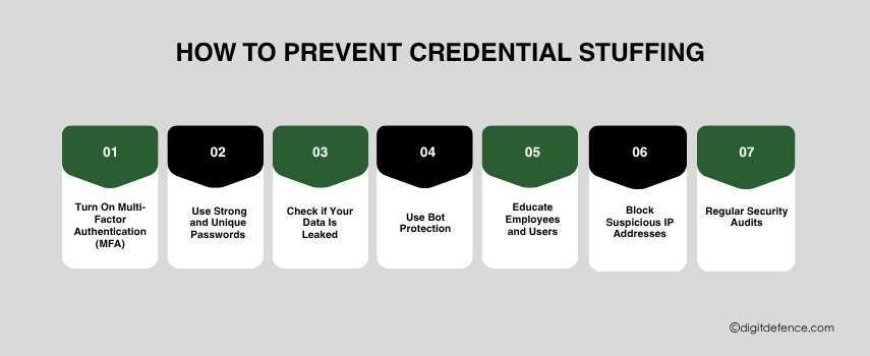
You can lower the risk of these attacks by following a few simple steps:
1. Turn On Multi-Factor Authentication (MFA)
MFA adds one more step during login, a code sent to your phone or email. Even if hackers know your password, they can’t log in without this code.
2. Use Strong and Unique Passwords
Don’t reuse passwords. Create different passwords for each account. A password manager can help you store and remember them safely.
3. Check if Your Data Is Leaked
Websites like Have I Been Pwned let you check if your email or password appeared in a data breach. If it has, change your password immediately.
4. Use Bot Protection
Companies should use bot detection tools and rate-limiting systems to stop automated login attempts.
5. Educate Employees and Users
Awareness is the best defense. Train employees and users to recognize risks like password reuse or suspicious login alerts.
6. Block Suspicious IP Addresses
Businesses can use geofencing or IP blacklisting to stop access from unknown or risky locations.
7. Regular Security Audits
Every company should check its systems often to find weak points and fix them before hackers exploit them.
Difference Between Credential Stuffing and Brute-Force Attacks
|
Aspect |
Credential Stuffing |
Brute-Force Attack |
|
Method Used |
Uses real usernames and passwords stolen from data breaches |
Tries to guess passwords by testing many combinations |
|
Data Source |
Relies on previously leaked or stolen credentials |
No prior data, relies on guessing techniques |
|
Speed of Attack |
Very fast using bots and automation tools |
Slower, as every password must be guessed |
|
Success Rate |
High if users reuse passwords across accounts |
Lower, especially against strong passwords |
|
Detection |
Harder to detect since logins appear legitimate |
Easier to detect due to repeated failed attempts |
|
Prevention |
Unique passwords, multi-factor authentication, bot protection |
Strong password policies, CAPTCHA, and account lockouts |
Future of Credential Stuffing and Cyber Defense Trends
Credential stuffing attacks are becoming smarter and harder to detect. Hackers now use AI-powered bots that can act like real users, change IP addresses, and avoid common security filters. This means traditional protection methods are no longer enough.
In the coming years, businesses and cybersecurity experts will move toward more intelligent and proactive defense systems.
Key Trends to Watch:
-
AI and Machine Learning Security:
These tools will help detect suspicious login patterns and stop automated attacks in real time.
-
Passwordless Authentication:
Methods like biometric logins, one-time passkeys, and device-based authentication will reduce the use of weak or reused passwords.
-
Zero Trust Security Model:
Every access request will be verified, no user or device will be trusted automatically, even inside the network.
-
Behavioral Analytics:
Systems will study user behavior (like typing speed or login times) to detect unusual activity instantly.
-
Increased User Awareness:
Companies will train employees and customers about password hygiene, phishing risks, and safe online practices.
Credential stuffing might seem small, but it can cause serious problems if ignored. Millions of stolen usernames and passwords are available online, putting both individuals and businesses at risk. Acting now is much easier than dealing with the damage later.
The best protection includes using strong, unique passwords, enabling multi-factor authentication, and keeping an eye on login activity. Businesses should also use security tools that spot unusual activity before it becomes a bigger problem.
By following good password habits, being cautious online, and monitoring accounts regularly, you can greatly reduce the risk of credential stuffing and protect your valuable information.