Internet Security or Illusion? What You’re Missing
Learn why basic online safety may fail and discover how Internet Security can safeguard your business, data, and digital identity from hidden threats.
Have you ever felt confident about your online safety, only to suddenly feel uncertain when something unusual happens on your device, email, or account?
It happens more often than people admit.
One small moment can shake the belief that everything is secure.
Maybe you have seen an email that felt suspicious.
Maybe your phone showed a login alert from a location you don’t recognize.
Maybe a file disappeared or changed without explanation.
Maybe a payment notification arrived that you never initiated.
In those moments, an uncomfortable question appears in the mind:
Was your digital life truly safe, or were you only assuming it was?
Many people, including business owners, working professionals, students, freelancers, and even technology users who believe they are careful, experience the same doubt.
This gap between belief and reality is where the illusion begins.
Why People Believe They Are Safe Even When They Aren’t
There is a curious psychological pattern when it comes to online safety. Users believe they are protected, not because they understand security, but because they have not yet seen the consequences of insecurity.
This leads to assumptions such as:
-
My devices already come with built-in protection
-
Hackers only go after large corporations or famous individuals
-
I don’t have valuable information that anyone would want
-
A basic password is enough to stay safe
-
If nothing bad has happened yet, it probably won’t
These assumptions are comforting, but they are false.
Cyber attackers do not look for important people.
They look for easy people.
They look for users who reuse passwords.
They look for businesses with weak systems.
They look for employees who click without thinking.
They look for people who feel safe enough to ignore risks.
Attacks today do not require a criminal genius sitting in a dark room. Many attacks are automated, affordable, copied from online tutorials, or purchased as ready-made tools. Criminals treat cyber attacks like a scalable business, not a personal mission.
That means you don’t have to make a mistake to be targeted.
You only have to exist online.
The Illusion of Safety in a Digital World
In the physical world, safety is visible.
We lock doors.
We check our surroundings.
We avoid dark alleys.
We secure valuables.
Online, danger is invisible.
That is why people behave differently.
They click links without hesitation.
They store information without encryption.
They trust networks without checking.
They believe safety is automatic.
The illusion feels comfortable.
But comfort is not protection.
The digital world is far more fragile than most people realize. Data can be copied, stolen, erased, or leaked without you ever noticing it happened.
And the more digital our lives become, the more that illusion costs us.
The Moment That Changes Everything
Most people start caring about Internet Security only after something has gone wrong. The triggering events are often small at first, but the impact grows quickly.
It could be:
A business discovers that customer data is missing.
A personal email is being accessed by someone unknown.
A laptop that suddenly freezes from ransomware.
A company's reputation was silently damaged by a breach.
A payment account reflecting unauthorized activity.
Private conversations appear somewhere they don’t belong.
The emotional response is the same every time:
Shock at how easily it happened.
Fear of what else might be exposed.
Regret for not acting sooner.
The regret does not come from the attack itself.
It comes from the realization that prevention was possible.
What You’re Really Missing
Internet Security is not just about installing antivirus software or choosing a slightly stronger password. It is not something that can be activated once and then forgotten. Real protection requires awareness, preparation, and continuous attention.
It is about something larger and far more personal:
Protecting your identity
Protecting your business operations
Protecting your financial access
Protecting your privacy
Protecting your reputation
Protecting your long-term stability
Every important aspect of modern life has moved online.
Your bills are online.
Your work files are online.
Your contacts are online.
Your photos and memories are online.
Your banking access is online.
Your goals and ambitions depend on systems that require connectivity.
If the digital world collapses, your real world collapses with it.
The Hidden Cost of Being Unprotected
The consequences of weak security are much deeper than most people imagine.
Cyber attacks don’t only steal data. They steal time, energy, confidence, and mental peace. They cause frustration, embarrassment, and uncertainty. They disrupt business continuity, destroy customer trust, delay progress, and create lasting doubt.
The emotional cost includes:
The anxiety of knowing someone accessed your information
The embarrassment of admitting a breach to clients, family, or colleagues
The panic of not knowing what else could be compromised
This is why Internet Security matters.
Not just for technology.
The New Digital Reality
We now live in a world where:
AI tools can guess passwords within seconds
Emails pretending to be real can fool even smart users
Fake websites look identical to the official ones
Malware hides without visible symptoms
Private data is bought and sold like a product
Cyber criminals operate like organized companies
This creates a simple truth:
Internet Security is not optional anymore.
It is a basic requirement for living and working online.
Yet people still delay protection because they believe they have time.
But the danger doesn’t wait.
It doesn’t announce itself.
It doesn’t give warnings.
The belief that “it won’t happen to me” is the most dangerous illusion of all.
Illusion vs Real Security
Here is the real difference between feeling safe and being safe, and why Internet Security cannot rely on assumptions.
|
Illusion of Security |
Reality of Security |
|
Antivirus alone is enough |
Security needs multiple layers of protection |
|
Using the same password everywhere |
Strong and unique passwords for every account |
|
Small businesses are not targets |
Hackers attack small and mid-size businesses more often |
|
Software updates can wait |
Updates must be done quickly to close vulnerabilities |
|
Trusting every link, email, or message |
Always verify before clicking or sharing |
|
Feeling safe because nothing bad has happened yet |
Monitoring and alerts prevent silent attacks |
|
Cyber attacks are rare |
Cyber attacks are common and increasing every year |
|
Public Wi-Fi is harmless |
Public networks can expose data and access |
|
Privacy settings don’t matter |
Privacy controls protect identity |
|
Security is a one-time task |
Security must be ongoing and actively maintained |
The illusion feels effortless.
Real protection requires awareness and action.
But the payoff is safety, stability, confidence, and control.
Warning Signs Your Online Safety Is Already in Trouble
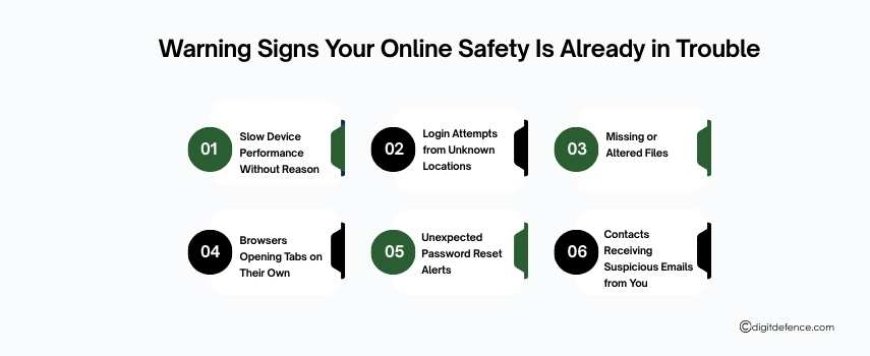
Many users overlook early warning signs simply because they do not recognize them. These signals suggest that your digital environment may already be compromised, observed, or vulnerable.
-
Slow Device Performance Without Reason
A sudden drop in speed can mean hidden activity or unwanted software.
-
Login Attempts from Unknown Locations
Someone may be trying to access your accounts without permission.
-
Missing or Altered Files
Data changing on its own is a strong sign of breach or tampering.
-
Browsers Opening Tabs on Their Own
This often indicates malware or remote control access.
-
Unexpected Password Reset Alerts
Hackers may be trying to take over your accounts.
-
Contacts Receiving Suspicious Emails from You
Your email or device may already be compromised.
What You Can Do Right Now
Here are practical steps that anyone can start immediately. No technical expertise required.
-
Use strong and unique passwords
-
Turn on two-factor authentication
-
Avoid unknown or unsecured Wi-Fi networks
-
Update software and devices without delay
-
Do not click links from unverified senders
-
Backup important data safely
-
Use tools that protect in real time
-
Limit personal information shared online
-
Review privacy settings on social platforms
-
Work with a trusted cyber security partner if you have a business
Small steps prevent big consequences.
Security is built one decision at a time.
The Future Belongs to the Protected
Every day without protection increases exposure.
Every delay increases vulnerability.
Every assumption increases risk.
Successful people do not wait for disaster.
Businesses that grow do not gamble with safety.
Leaders do not rely on luck.
This is why Internet Security becomes the foundation of confidence in a digital society.
Ask yourself honestly:
Are you protected, or are you simply hoping nothing happens?
Hope is uncertain.
Security is empowering.
The Internet Is Only Safe if You Make It Safe
Your online world deserves protection.
Your business deserves stability.
Your future deserves confidence.
The illusion ends here.
Ready to protect what matters?
Get reliable cyber protection that keeps you safe, confident, and ahead.
Start your journey with DigitDefence today.