
Is Identity Theft Protection Enough to Secure My Financial Accounts?
Learn whether identity theft protection alone can secure your financial accounts and explore essential steps to strengthen your online safety
Have you ever opened your banking app and felt a sudden wave of fear rush through your body?
Your eyes freeze.
Your fingers stop moving.
Your mind starts racing.
Maybe you noticed a strange transaction you did not make.
Maybe you received an alert saying your login was used somewhere else.
Maybe someone you know became a victim, and you wondered if you might be next.
This fear is becoming common, and it has nothing to do with how smart, educated, or careful someone is. It happens because our money no longer lives in a physical place. It lives behind screens, apps, passwords, cloud systems, and digital gates we cannot see or touch.
So it feels natural to look for something that promises safety. Many people turn to Identity theft protection believing it is enough to stop financial fraud, prevent account hacking, and block criminals before they strike.
But here is the real truth most people are not told:
Identity theft protection may help, but it is not enough to fully secure your financial accounts.
And the most painful part?
Most people only discover this after the damage has already happened.
This is why we need to talk about it openly - in simple words, without complicated cyber terms, without fear-based manipulation, and without pretending everything online is safe.
Because your identity, your financial future, and your peace of mind deserve clarity.
Why do people believe it is enough
People trust it because it makes them feel protected. It seems like a safety net because it:
-
watches for unusual activity
-
alerts you if your information appears somewhere suspicious
-
notifies you if someone tries to use your details
-
tracks changes to credit or accounts
In a digital world filled with phishing messages, fake banking pages, scam calls, data leaks, hacked apps, and stolen passwords, even a little safety feels comforting.
But emotional comfort and real protection are not the same thing.
There is a big difference between being informed and being protected.
Think of it like a smoke alarm.
A smoke alarm tells you when there is a fire
But it does not stop the flames, protect your belongings, or prevent the damage.
In the same way, Identity theft protection only alerts you after danger has already started. It does not stop criminals from entering your accounts or blocking their access before the money disappears.
And that is where the false sense of safety becomes risky.
The Emotional Cost Nobody Talks About
When someone gains access to your financial accounts or personal identity, the damage goes far deeper than your bank balance.
It feels like:
-
losing control of your own life
-
being violated without seeing the attacker
-
doubting every message, call, or notification afterward
-
feeling embarrassed even when it was not your fault
-
living with fear that it could happen again
Statistics make it even more real:
-
Someone becomes a victim of identity fraud every 22 seconds
-
One out of every three adults has already had personal data exposed
-
Most people discover it long after the crime has happened
And here is the part most people never expect:
Your information can be stolen even if you never clicked a bad link or shared anything carelessly.
Why?
Because data leaks happen everywhere, including places you don’t think about, such as:
-
hotel booking platforms
-
mobile service providers
-
food delivery apps
-
online shopping databases
-
workplace systems
-
educational records
-
medical registrations
So even if you are careful, someone else’s system can expose you.
That is why, depending only on Identity theft protection creates gaps you cannot see.
What it actually does
To put it in simple words, it:
-
alerts you
-
monitors your identity
-
helps with recovery after something happens
These things matter. They reduce damage and make cleanup easier.
But here is the important truth:
Monitoring is only the first layer of protection - not the whole shield.
To secure your financial accounts, you need more than alerts.
What it cannot protect
It cannot fully prevent:
-
bank login theft
-
payment wallet and UPI account takeover
-
SIM card swapping
-
Scam calls pretending to be official bank staff
-
malware that steals passwords and OTPs
-
attacks caused by reusing the same password
-
fake banking websites that look identical to real ones
-
AI-generated voice fraud
Depending only on Identity theft protection is like locking the front door while leaving windows wide open.
Criminals don’t need the door if another entry is easier.
So what actually keeps your financial accounts safe?
Real digital protection needs layers, such as:
Strong password habits
No repeating passwords across apps, banking, email, or social media.
Two-factor authentication that does not rely on SMS
Because SMS can be intercepted or stolen.
Updated devices and apps
Old software has open security holes.
A password manager
So you don’t rely on memory or guessable variations.
Scam and phishing awareness
You cannot protect yourself from what you don’t recognize.
Secure Wi-Fi and network habits
Public networks expose financial data.
Dark web exposure checks
To know if your information is already out there.
Professional guidance
Because criminals evolve faster than the average user can understand.
And this is where the real difference lies.
Identity theft protection is one piece of the puzzle - but it cannot replace full, layered financial security
Simple Steps You Can Take Right Now to Secure Your Financial Accounts
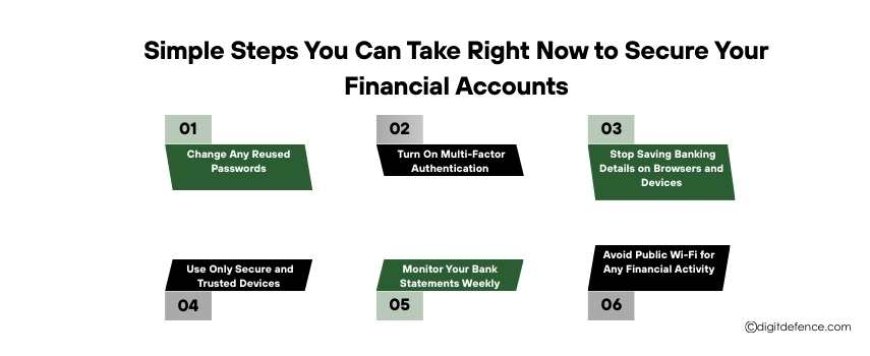
You don’t need to be a tech expert to protect your money. Small actions can make a big difference, and you can start today. Here are simple steps that anyone can follow, even with a busy lifestyle:
1. Change Any Reused Passwords
If one account gets hacked, all others with the same password become open doors.
Choose long, unique passwords for banking, UPI, credit cards, and investment apps.
2. Turn On Multi-Factor Authentication
This adds a second lock to your accounts.
Even if someone knows your password, they still cannot enter without the second verification.
3. Stop Saving Banking Details on Browsers and Devices
Auto-save feels convenient, but it puts your financial accounts at risk if someone accesses your device.
4. Use Only Secure and Trusted Devices
Do not log into banking apps on shared computers, office laptops, or public devices.
5. Monitor Your Bank Statements Weekly
Small, unknown transactions are often the first warning sign before larger fraud happens.
6. Avoid Public Wi-Fi for Any Financial Activity
Public networks can leak login details without you knowing.
Why it matters more now than ever
Today's cybercriminals are not acting alone and are not working manually. They are:
-
automated
-
coordinated
-
trained
-
funded
-
anonymous
-
and powered by AI
Fake voices sound real.
Fake websites look perfect.
Fake alerts look official.
This means:
People who prepare stay safe.
People who wait become victims.
There is no neutral zone anymore.
Doing nothing is the same as inviting risk.
So, is Identity Theft Protection enough to secure your financial accounts?
The honest answer: No.
It is helpful, it provides alerts, and it offers recovery support.
But it does not prevent the attack itself.
If your savings matter,
If your privacy matters,
If your future matters,
Then alerts alone are not enough.
You deserve more than a warning.
You deserve protection that stops danger before it reaches you.
How DigitDefence helps secure what truly matters
DigitDefence provides real, layered protection for individuals and businesses by offering:
-
protection against account takeover
-
prevention-focused cyber practices
-
scam and fraud awareness guidance
-
device and network security
-
Ongoing monitoring with action-oriented support
-
expert help the moment something feels suspicious
You do not need tech knowledge.
You do not need experience.
You only need the willingness to protect yourself before it’s too late.
Your identity. Your money. Your tomorrow.
Do not wait for the alert that arrives after the damage.
Start your journey with DigitDefence today - and feel protected before something goes wrong, not after.
Security is no longer a luxury.
It is a responsibility to yourself and your future.