How Does Quantum Cryptography Help Business Security?
Explore how quantum cryptography enhances business security by securing communication and protecting sensitive data from cyber threats.

For data protection, many companies still use traditional encryption methods that have been effective for years. However, quantum computing is making these methods less secure. To protect critical data, businesses need to adopt Quantum Cryptography, which offers stronger security as technology advances.
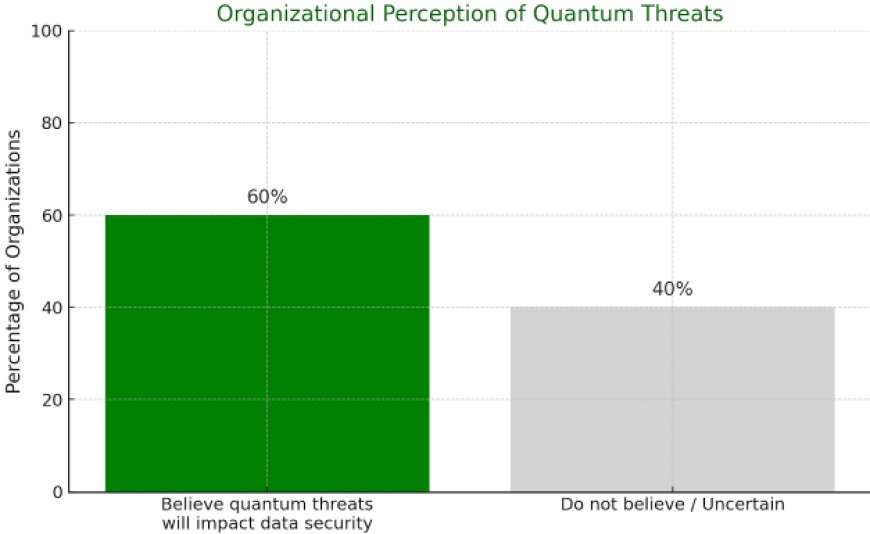
Studies show that over 60% of organizations believe quantum threats will impact their data security within the next five years.
IBM worked with Vodafone to improve the security of Vodafone’s Secure Net service, which millions of people use. Vodafone wanted to prepare for future risks from quantum computers that could break today’s encryption.
Vodafone’s current encryption methods, like RSA and TLS, are strong now but could be cracked by quantum computers in the future. This means sensitive data could be at risk if attackers save encrypted data today to decode later.
IBM helped Vodafone add new quantum-safe encryption alongside its existing systems. This mix keeps data safe now and protects it against future quantum threats, without needing to replace everything.
What Is Quantum Cryptography?
Quantum cryptography is a modern cybersecurity technique that uses the laws of quantum mechanics to protect sensitive information. Unlike traditional encryption, which depends on mathematical algorithms, this cryptography secures data by transmitting it through quantum particles such as photons.
The most widely known method in this field is Quantum Key Distribution (QKD). QKD enables two parties to create and share a secret encryption key in a way that automatically detects any third-party interference. If a hacker tries to eavesdrop, the quantum state of the data changes, alerting both users to the intrusion.
This method ensures data confidentiality, key integrity, and forward secrecy, making it highly valuable for securing government systems, financial transactions, and critical infrastructure. As cyber threats grow and quantum computing advances, this offers a future-ready defense model against data breaches.
Understanding Quantum Key Distribution (QKD)
Quantum Key Distribution (QKD) is the foundational technology behind quantum cryptography. It is a proven system already implemented in real-world communication networks.
QKD enables two parties to exchange encryption keys securely by utilizing quantum physics principles, specifically the behavior of photons (light particles).
-
Instead of transmitting keys over standard internet channels, QKD sends photons through dedicated fiber-optic or quantum communication links.
-
Each photon encodes a quantum bit (0 or 1) in a quantum state.
-
Any interception attempt alters the state of these photons, immediately revealing eavesdropping.
-
Upon detecting interference, the communicating parties discard the compromised key and generate a new one.
This process ensures secure key exchange by actively detecting and preventing unauthorized access during transmission.
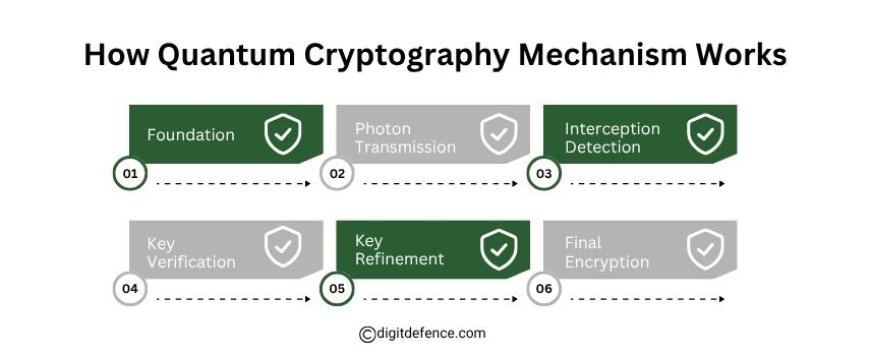
How Quantum Cryptography Mechanism Works
-
Foundation: Quantum cryptography is a cybersecurity method based on quantum mechanics principles, focusing on secure key exchange via Quantum Key Distribution (QKD).
-
Photon Transmission: Encryption keys are encoded in the polarization states of photons sent through a quantum channel (e.g., fiber optics). These quantum particles cannot be copied or measured without alteration.
-
Interception Detection: Due to the Heisenberg Uncertainty Principle, any attempt to observe or intercept photons changes their state, signaling a potential security breach.
-
Key Verification: After transmission, the sender and receiver compare measurement bases through a classical channel. Non-matching bits are discarded.
-
Key Refinement: The remaining bits undergo error correction and privacy amplification to produce a secure cryptographic key.
-
Final Encryption: This shared key is applied in symmetric encryption algorithms such as AES or One-Time Pad, providing security based on physical laws rather than computational difficulty.
Post-Quantum Cryptography vs Quantum Cryptography
|
Post-Quantum Cryptography |
Quantum Cryptography |
|
Uses classical algorithms resistant to quantum attacks |
Uses quantum physics for key exchange |
|
Runs on classical computers |
Requires quantum communication devices |
|
Does not need specialized quantum hardware |
Depends on the quantum properties of particles |
|
Focuses on mathematical problems for security |
Security based on physical laws |
|
Can be implemented with software updates |
Requires new quantum communication infrastructure |
How Quantum Cryptography Secures Business Data
It protects sensitive information, especially in sectors like finance, healthcare, defense, and companies handling customer identities or proprietary data.
Key Points:
-
Immediate Breach Detection: Unauthorized access changes quantum states, triggering instant alerts.
-
Secure Communication: Protects internal messages, financial transactions, and remote access during key exchanges.
-
Prevents Man-in-the-Middle Attacks: Any attempt to intercept or copy encryption keys is detected immediately.
-
Limits Insider Threats: Internal access attempts to keys raise alerts right away.
Example:
A healthcare provider uses quantum cryptography to protect patient data transfers. Any interception attempt during encryption key exchange is detected instantly, helping to prevent data breaches.
This method acts like a digital tripwire, alerting organizations to cyber threats the moment they occur, allowing quick response to reduce damage.
Why Quantum Cryptography is the Future of Business Security?
-
Increasing Cyber Threats: Cyberattacks are becoming more sophisticated, resulting in significant financial and reputational losses.
-
Limitations of Classical Encryption: Current algorithms like RSA and ECC depend on mathematical problems vulnerable to quantum computing advancements.
-
Quantum Key Distribution (QKD): Employs principles of quantum mechanics to enable secure key exchange that is inherently resistant to interception.
-
Real-Time Intrusion Detection: Any eavesdropping attempt alters the quantum states, immediately alerting communicating parties.
-
Information-Theoretic Security: Provides security based on physical laws rather than computational complexity, ensuring protection against future quantum attacks.
-
Strategic Necessity: Adopting this method safeguards critical business data and maintains customer trust in a rapidly evolving threat landscape.
Quantum cryptography provides advanced security by using quantum physics to protect data and detect attacks immediately. It helps businesses defend against current and future cyber threats, maintaining trust and minimizing risk.
Concerned about securing your data with quantum cryptography?
Get expert guidance. Email us at [email protected].