
AI vs ML: The Future of Cybersecurity
Explore AI vs ML in cybersecurity, their roles, benefits, and how they work together to protect businesses from changing cyber threats.

Have you ever thought what happens if a hacker gets into your system before you even know?
What if your business is attacked while you are sleeping?
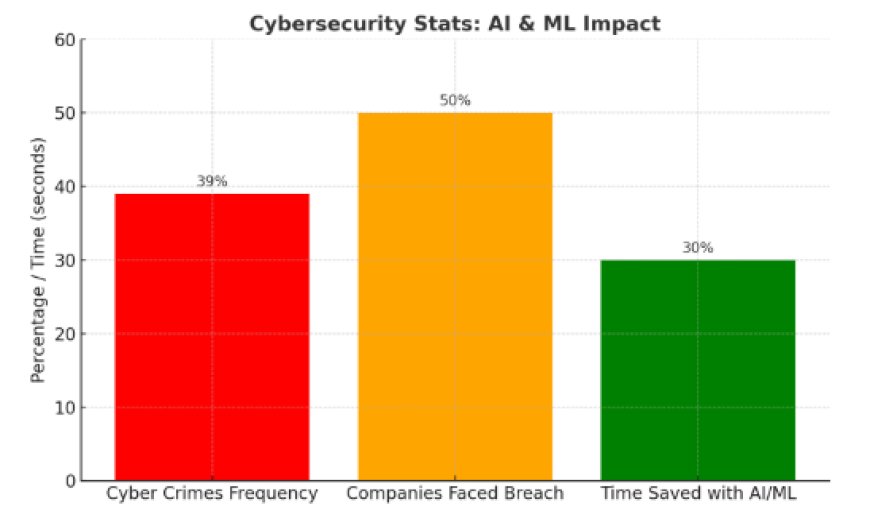
Today, cyber crimes happen every 39 seconds, and over 50% of companies have faced a data breach in the last year. Businesses that utilize AI and ML in security save 30% more time in detecting threats compared to traditional methods.
In 2023, Microsoft faced a serious nation-state cyber attack targeting government organizations. Hackers tried to hide inside normal network activity, making it harder to detect. Microsoft used AI and Machine Learning to watch billions of signals every day.
The attack involved a massive amount of data to analyze in real time. Hackers disguised their activity through normal-looking logins, and manual monitoring was too slow to respond effectively.
AI scanned signals to spot unusual patterns instantly, while Machine Learning learned from past attacks to predict new threats. This combination blocked the attack before any sensitive data was stolen.
What is Artificial Intelligence in Cybersecurity?
Artificial Intelligence (AI) in cybersecurity refers to systems that mimic human intelligence, learning, reasoning, and making decisions. In security, AI helps:
-
Analyze massive datasets for threat indicators
-
Adapt to new attack strategies
-
Automate real-time decision-making for incident response
AI can be trained to understand patterns in cyberattacks, allowing it to identify suspicious behavior before it becomes a breach.
What is Machine Learning in Cybersecurity?
Machine Learning (ML) is a subset of AI that focuses on algorithms learning from data without being explicitly programmed. In cybersecurity, ML can:
-
Recognize anomalies in user behavior
-
Predict potential attack points
-
Improve over time with each new dataset
The machine learning vs AI distinction is important- ML specializes in data-driven learning, while AI is broader, incorporating reasoning and decision-making capabilities.
Machine Learning vs AI: How They Differ in Cybersecurity
|
Aspect |
Artificial Intelligence (AI) |
Machine Learning (ML) |
|
Scope |
AI is an umbrella concept that covers multiple technologies, including ML, deep learning, natural language processing (NLP), and expert systems. Cybersecurity involves everything from real-time decision-making to automated threat hunting. |
ML is a subset of AI focused specifically on enabling systems to learn from historical data without explicit programming. In cybersecurity, ML models specialize in recognizing patterns and detecting anomalies in large datasets. |
|
Function |
AI simulates human-like intelligence to make strategic security decisions, automate threat responses, and analyze complex attack vectors. It can assess risk levels, prioritize incidents, and even recommend remediation steps based on context. |
ML uses statistical models to analyze previous cyber incidents, identify patterns, and forecast potential threats. Its primary role is predictive — flagging suspicious activities before they escalate into full-scale breaches. |
|
Adaptability |
AI can process unstructured and structured data from multiple sources, adapting to complex, evolving, and multi-layered cyberattack scenarios. It’s ideal for responding to zero-day vulnerabilities and advanced persistent threats (APTs). |
ML models become more accurate as they are exposed to more training data. Over time, they refine their algorithms to detect new attack patterns, but they may need retraining when completely new threat types emerge. |
|
Example |
AI-powered Security Orchestration, Automation, and Response (SOAR) platforms that autonomously investigate and resolve security alerts without human intervention. |
Email security filters that learn from past spam and phishing attacks to block similar threats in the future. |
How AI and Machine Learning Work Together in Cybersecurity
Artificial Intelligence (AI) and Machine Learning (ML) are often compared in the machine learning vs AI debate, but in cybersecurity, they are more complementary than competitive. AI acts as the broader system capable of decision-making and automation, while ML serves as the engine that enables AI to “learn” from vast amounts of data and improve over time.
When combined, AI provides the strategic intelligence, such as detecting anomalies, predicting attack patterns, and automating responses, while ML refines the process by analyzing historical threats, identifying patterns, and improving detection accuracy with every incident.
Challenges in Using Machine Learning vs AI for Cybersecurity
While AI and ML offer transformative potential in defending against cyber threats, adopting them is not without obstacles. Businesses must address these key challenges to maximize their effectiveness:
-
Bias in Training Data – If the training datasets are incomplete, unbalanced, or outdated, AI and ML models may misinterpret patterns, leading to false positives or missed threats. In cybersecurity, this could mean wasting resources on harmless alerts while overlooking real cyber attacks.
-
Adversarial Attacks – Cybercriminals are becoming more sophisticated, deliberately crafting inputs that deceive AI/ML algorithms into making wrong decisions. This could allow malicious activity to bypass detection entirely.
-
High Implementation Costs – Advanced AI-driven security tools require significant investment in infrastructure, software licenses, and skilled personnel. For small and mid-sized businesses, this cost barrier can slow adoption.
These challenges highlight why businesses should not only compare machine learning vs AI capabilities but also plan for robust governance, continuous model training, and layered defenses to keep systems resilient against evolving threats.
Steps to Implement AI & ML in Cybersecurity
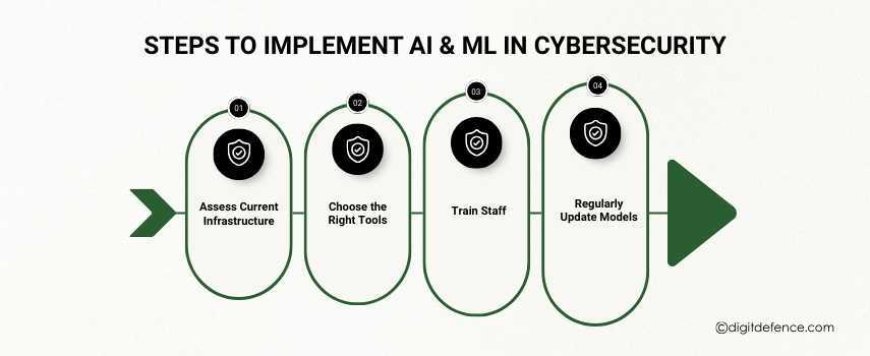
Successfully integrating AI and ML into your cybersecurity strategy requires a structured approach. Here’s a roadmap businesses can follow:
-
Assess Current Infrastructure – Conduct a thorough audit of existing security systems to pinpoint where automation and predictive analysis can enhance threat detection and response times.
-
Choose the Right Tools – Invest in trusted AI-powered SIEM (Security Information and Event Management) platforms or other security solutions that align with your industry’s compliance and operational needs.
-
Train Staff – Ensure your security team and relevant employees understand how AI and ML systems operate, so they can interpret alerts, validate results, and respond effectively.
-
Regularly Update Models – Continuously feed fresh threat intelligence into your AI/ML systems to keep them accurate and resilient against evolving cyberattack tactics.
By following these steps, organizations can harness the strengths of machine learning vs AI while ensuring a robust, adaptable defense against emerging threats.
Future of Machine Learning vs AI in Cybersecurity
The future of machine learning vs AI in cybersecurity is moving toward a more predictive, adaptive, and autonomous defense system. Rather than reacting to threats after they occur, upcoming solutions will anticipate attacks before they happen.
Key trends shaping the future:
-
Predictive Threat Intelligence – AI and ML will forecast attack patterns based on global data, preventing breaches before they start.
-
Self-Healing Security Systems – AI will automatically patch vulnerabilities without human intervention.
-
Deepfake & Synthetic Media Detection – ML algorithms will identify and block advanced social engineering threats.
-
Collaborative AI Models – Multiple organizations will share anonymized threat intelligence, enabling stronger collective defense.
Cybersecurity threats are getting smarter, quicker, and harder to predict. Using only old security tools is not enough anymore; machine learning vs AI is now a real need, not just a topic for discussion, for any business that wants to protect its data. Businesses that combine AI’s smart decision-making with ML’s ability to learn and adapt will be stronger in stopping, finding, and handling cyberattacks.
"Don’t wait for the breach, stop it before it starts. Contact us today at [email protected] to explore AI & ML-powered cybersecurity solutions for your business."