
How Zero Trust Network Access Simplifies Cybersecurity?
Learn how Zero Trust Network Access simplifies cybersecurity and keeps your data safe without complicated setups
Can your business truly trust every user, device, and network connection today? What if the person accessing your system isn’t who they claim to be?
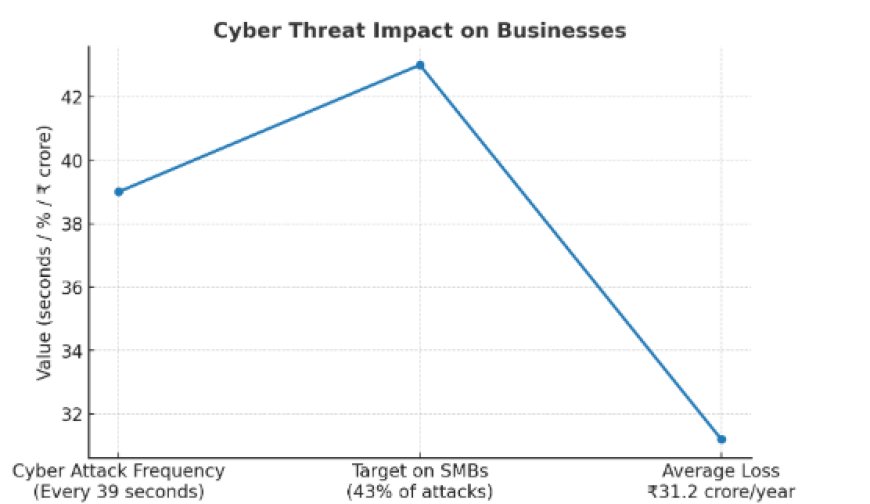
Cyber threats are rising at a speed businesses can’t ignore. Every 39 seconds, a cyber attack takes place somewhere in the world. Nearly 43% of these attacks specifically target small and medium-sized businesses. On average, organizations lose around ₹31.2 crore every year in breach-related costs.
Google, through its “BeyondCorp” initiative, implemented a Zero Trust model across its global workforce. Instead of relying on VPNs, Google enabled employees to securely access applications from anywhere without needing to “trust” the corporate network by default.
This approach not only reduced breaches but also simplified security operations for thousands of employees worldwide.
This is where Zero Trust Network Access (ZTNA) comes into play. Unlike traditional perimeter-based security, ZTNA works on the principle of “never trust, always verify.”
What is Zero Trust Network Access?
Zero Trust Network Access (ZTNA) is a security framework that ensures every user, device, and application request is continuously authenticated and authorized before granting access. Unlike VPNs, which assume users inside the network are “trusted,” ZTNA requires strict verification, no matter where the user is located.
In simple terms, ZTNA removes the assumption of trust and instead enforces policies dynamically, based on identity, device health, and context.
Core Principles of Zero Trust Network Access
At its foundation, Zero Trust Network Access (ZTNA) is built on the idea of “never trust, always verify.” Unlike traditional models that assume everything inside a network is safe, Zero Trust enforces strict verification for every user, device, and application request.
1. Identity Verification
Access is granted based on user identity, not location. Every login attempt is authenticated using multi-factor authentication (MFA) and contextual signals such as device type, geolocation, and behavior patterns.
2. Least Privilege Access
ZTNA ensures users only get the minimum access required for their role. By limiting access rights, it reduces the damage potential if credentials are stolen.
3. Micro-Segmentation
Instead of treating the network as one large perimeter, ZTNA divides it into smaller, isolated zones. This prevents attackers from moving laterally within the system once they breach an endpoint.
4. Continuous Monitoring and Validation
Access is not a one-time decision. ZTNA continuously checks user activity, device health, and network behavior to detect anomalies in real time.
5. Adaptive Security Controls
Security policies adapt dynamically depending on risk levels. For example, if a login is attempted from an unusual location, the system can demand additional verification before granting access.
How Zero Trust Network Access Simplifies Cybersecurity
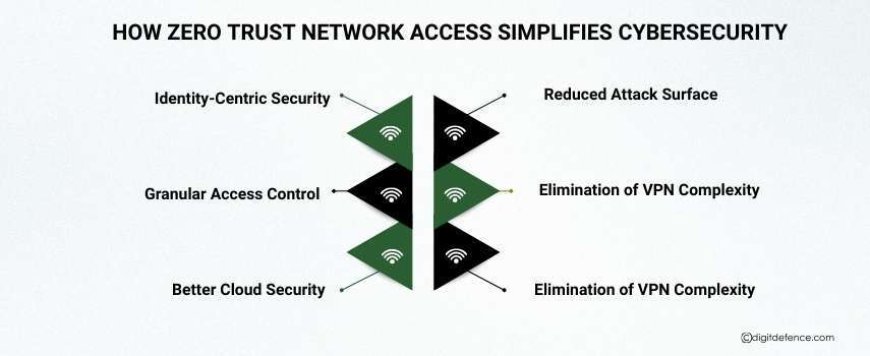
1. Identity-Centric Security
ZTNA ensures that access is granted based on user identity, not just location. Even if someone logs in from within the office network, they must prove their legitimacy through authentication checks.
Simplification: Businesses don’t have to maintain complicated firewall rules; security follows the user, not the network.
2. Granular Access Control
With ZTNA, employees only get access to the specific applications they need, not the entire network. For example, a marketing executive doesn’t need access to financial systems.
Simplification: This reduces the risk of lateral movement by hackers and lowers insider threat exposure.
3. Better Cloud Security
As companies move to SaaS platforms like Office 365, Salesforce, or AWS, traditional VPNs become clunky. ZTNA integrates seamlessly with cloud environments and applies consistent policies everywhere.
Simplification: One unified framework for both on-premise and cloud resources, removing the complexity of hybrid IT.
4. Reduced Attack Surface
With ZTNA, applications are never directly exposed to the internet. Instead, they remain hidden behind authentication layers. Hackers cannot even see or scan these applications.
Simplification: IT teams don’t need to juggle multiple intrusion prevention tools; ZTNA inherently limits what attackers can target.
5. Elimination of VPN Complexity
VPNs often slow down user productivity, require constant patching, and expand the attack surface. ZTNA provides direct, secure access without forcing all traffic through a centralized gateway.
Simplification: Faster, more efficient access for users, while security teams manage fewer tools.
6. Continuous Verification
Instead of one-time authentication at login, ZTNA constantly checks signals such as device posture, user behavior, and location.
Simplification: No reliance on static passwords or credentials alone, risk-based verification becomes automated.
Steps to Implement Zero Trust Network Access in Your Organization
Adopting Zero Trust Network Access (ZTNA) requires a structured approach. It’s not just a technology upgrade but a shift in mindset and policy. Below are the essential steps:
1. Assess Your Current Security Posture
Begin with a thorough audit of your existing network, devices, applications, and access points. Identify vulnerabilities, legacy systems, and high-risk areas where attackers could exploit weaknesses.
2. Define and Classify Critical Assets
Not every resource requires the same level of protection. Identify sensitive data, applications, and infrastructure that need the highest level of access control.
3. Adopt Strong Identity and Access Management (IAM)
Implement multi-factor authentication (MFA), single sign-on (SSO), and context-based access policies. Every access request should be tied to a verified identity.
4. Implement the Principle of Least Privilege
Restrict user access to only what’s necessary for their role. Regularly review and update permissions to reduce risks of insider threats or compromised accounts.
5. Enable Micro-Segmentation
Divide your network into smaller, secure zones. This ensures that even if one segment is compromised, attackers cannot move laterally across the entire system.
6. Integrate Continuous Monitoring
Deploy real-time monitoring tools powered by AI and analytics. These tools help detect unusual behaviors, flag anomalies, and respond to threats instantly.
Challenges Businesses Face While Adopting ZTNA
While Zero Trust Network Access (ZTNA) is a powerful security framework, businesses often encounter obstacles during implementation. Understanding these challenges is the first step toward addressing them effectively.
1. Complex Integration with Legacy Systems
Many organizations still rely on outdated infrastructure and applications. Integrating ZTNA with legacy systems can be difficult, often requiring additional upgrades or replacement of old technologies.
2. High Initial Costs
Adopting ZTNA involves investments in new tools, identity management systems, and continuous monitoring solutions. For small and medium-sized businesses, these upfront costs can be a major barrier.
3. Employee Resistance and Adaptation
Shifting from traditional access models to Zero Trust requires cultural change. Employees may resist stricter access controls or find the new verification steps inconvenient if not communicated properly.
4. Skill Gaps and Expertise Shortage
ZTNA implementation requires skilled cybersecurity professionals. Many businesses lack in-house expertise, making it challenging to design and manage an effective Zero Trust framework without external help.
5. Scalability Issues
As organizations grow, ensuring that ZTNA policies scale seamlessly across new users, devices, and cloud applications can be complex without proper planning.
Cybersecurity today is not about building bigger walls — it’s about making sure no one gets access without the right checks. Zero Trust Network Access (ZTNA) makes security easier by bringing cloud, devices, and identity protection into one simple system.
For businesses, using ZTNA is not just about staying safe. It also helps them grow securely, reduce IT problems, and build more trust with their customers.