How AI in Cyber Security Will Strengthen Risk Management?
Discover how AI in cybersecurity helps detect threats faster and makes risk management smarter, safer, and stronger for your business.
How safe is your business from online attacks?
What if you could stop a problem before it even starts?
Today, online dangers are growing every day. AI in Cybersecurity helps businesses stay safe by identifying signs of trouble, warning about risks, and resolving problems quickly. It works like a smart guard who never sleeps, watching over your data and keeping it away from danger.
Recent facts show that 80% of companies using AI in cybersecurity can find problems much faster than before. This speed means they can act before the damage gets worse. It also helps reduce the harm from attacks by 60%, which means fewer losses and less time spent fixing issues.

In the long run, using AI in Cyber Security can save a business more than ₹24.9 crore each year by avoiding costly damage and protecting important data.
In 2014, Sony Pictures Entertainment faced a massive cyber attack. Hackers gained access to the company’s internal network, stealing confidential emails, employee records, and unreleased movies.
The attack disrupted daily operations, halted film releases, and caused severe damage to Sony’s reputation. Sensitive business information was leaked publicly, increasing the risk of legal and financial losses.
Sony strengthened its cybersecurity measures by implementing advanced threat detection tools, multi-layer network security, and employee cyber awareness training. The company also partnered with global cybersecurity firms to monitor threats in real time.
Understanding AI in Cyber Security
AI in Cyber Security refers to the use of artificial intelligence and machine learning algorithms to detect, analyze, and respond to potential cyber threats in real time. Unlike traditional security tools that react after an incident occurs, AI systems predict and neutralize risks proactively.
Key capabilities include:
-
Threat Prediction: Identifying suspicious behavior before it becomes malicious.
-
Automated Response: Deploying countermeasures instantly to contain breaches.
-
Data Pattern Analysis: Spotting anomalies across vast datasets.
-
Adaptive Learning: Continuously improving from new threats and attack vectors.
How AI in Cyber Security Detects Threats Faster
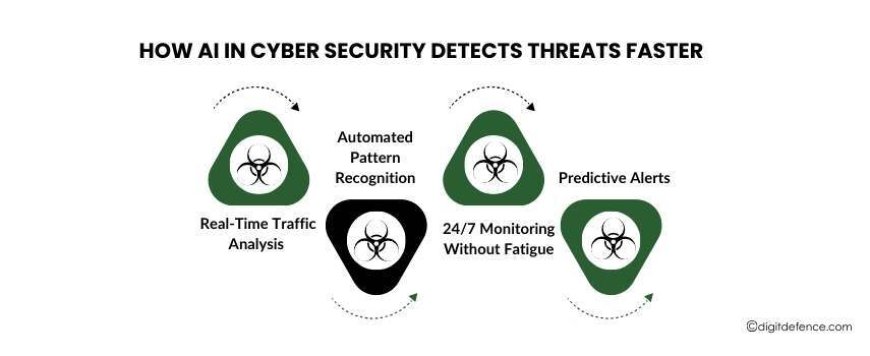
AI in Cyber Security uses machine learning algorithms, real-time data analysis, and behavioral analytics to spot unusual activities within seconds, something that traditional security tools might take hours or even days to identify.
Key ways it speeds up detection:
-
Real-Time Traffic Analysis – AI scans massive amounts of network data instantly, identifying suspicious IP addresses, malware signatures, or unauthorized access attempts.
-
Automated Pattern Recognition – Machine learning models learn from past attacks, allowing them to recognize new threats even when they haven’t been seen before.
-
24/7 Monitoring Without Fatigue – Unlike human analysts, AI operates round-the-clock without delays or oversight gaps.
-
Predictive Alerts – AI can forecast potential breaches by detecting anomalies before an attack occurs.
Why AI in Cyber Security is Essential for Risk Management
From financial fraud to ransomware, the cyber threat landscape has never been more dangerous for businesses. Here’s why AI makes a significant difference:
1. Real-Time Threat Detection
AI analyzes massive volumes of network traffic in milliseconds, enabling real-time detection of potential breaches.
2. Faster Incident Response
When a breach is detected, every second counts. AI-driven systems automatically isolate compromised devices or networks to stop the spread. This capability drastically reduces mean time to detect (MTTD) and mean time to respond (MTTR).
3. Enhanced Accuracy with Fewer False Positives
Traditional systems often flood security teams with false alerts. AI uses contextual analysis to filter out harmless activities, letting teams focus only on real threats.
4. Predictive Risk Assessment
AI can simulate attack scenarios, helping businesses understand vulnerabilities before hackers exploit them. This is crucial for proactive risk assessment
AI in Cyber Security vs. Traditional Risk Management
|
Feature |
AI in Cyber Security |
Traditional Cyber Security |
|
Speed |
Real-time detection and response |
Delayed detection, manual response |
|
Accuracy |
High precision with machine learning |
Higher false positives |
|
Scalability |
Handles vast data streams effortlessly |
Struggles with large-scale data |
|
Adaptability |
Learns from new threats instantly |
Requires manual updates |
|
Risk Prevention |
Predictive and proactive |
Reactive after an incident |
Industries Benefiting from AI in Cyber Security
1. Banking & Finance
AI prevents fraud by detecting irregular transactions instantly and verifying suspicious account activity.
2. Healthcare
AI protects sensitive patient data, detects ransomware attacks targeting hospital systems, and ensures compliance with privacy regulations.
3. E-commerce
AI defends against payment fraud, account takeovers, and large-scale bot attacks that can disrupt online operations.
4. Manufacturing
AI safeguards operational technology (OT) systems from sabotage or espionage, keeping production lines secure.
Challenges in Implementing AI in Cyber Security
While the benefits are clear, businesses must navigate a few challenges:
-
High Initial Costs: Advanced AI solutions can be expensive to implement.
-
Data Privacy Concerns: AI requires large datasets, which must be handled securely.
-
Skill Gap: Businesses may need to upskill teams to fully leverage AI tools.
However, the ROI from reduced breaches and improved risk control often outweighs these hurdles.
Best Practices for Businesses Adopting AI in Cyber Security
-
Assess Your Current Risk Landscape
Conduct a thorough audit to understand where AI can add the most value.
-
Integrate with Existing Systems
AI should complement, not replace, existing cybersecurity measures.
-
Train Your Teams
Ensure your security personnel understand how to interpret AI-driven insights.
-
Focus on Compliance
Make sure AI deployments meet industry regulations like GDPR, HIPAA, or PCI DSS.
-
Choose Scalable Solutions
Select AI tools that can grow with your business and handle increasing data volumes.
The Future of AI in Cyber Security for Risk Management
As cyberattacks become more sophisticated, AI in Cyber Security will be essential for:
-
Autonomous Security Operations: Systems capable of handling most threats without human intervention.
-
Deepfake & Social Engineering Detection: AI will recognize and block advanced manipulation attempts.
-
Cross-Industry Threat Sharing: AI platforms sharing data across sectors to predict and block threats faster.
-
Quantum-Resistant Cyber Defense: AI will help design encryption and threat detection systems resistant to future quantum-computing attacks.
-
Predictive Threat Modeling: AI will analyze patterns and simulate attack scenarios to anticipate and prevent breaches before they happen.
Today, in business, finding and stopping problems quickly is very important. AI in Cyber Security helps by thinking fast, working on its own, and guessing problems before they happen. Companies that use it now are not just safe today - they are making sure they stay safe in the future too.
Need strong cyber protection for your business? Email us at [email protected]