What is an SQL Injection Attack? A Beginner’s Guide
Is your website vulnerable to hackers? Learn What is an SQL Injection Attack and how to protect your data from cyber threats before it's too late!

As a cybersecurity specialist, I’ve seen how SQL Injection (SQLi) attacks can disrupt databases, exposing sensitive user data, login credentials, and financial records. One simple SQL injection vulnerability in a website’s database security can allow hackers to manipulate and exploit an entire system.
When I first started in cybersecurity, I was shocked by how easily hackers could use SQL Injection to steal and modify data without being detected. It’s a method that has existed for over two decades, yet many websites remain vulnerable to database security risks. Understanding what is SQL Injection Attack, how it works, and how to prevent it is essential for businesses, developers, and security professionals. Here, I’ll share everything you need to know about SQL Injection Attacks, their impact on cybersecurity threats in databases, and the best SQL injection prevention techniques to protect your data.
What is an SQL Injection Attack?
SQL Injection (SQLi) Attack is a type of cyber attack where a hacker injects malicious SQL code into a website’s input fields (such as login forms, search boxes, or URLs) to manipulate or access the underlying database. This attack occurs when a web application fails to properly validate user input, allowing hackers to execute unauthorized SQL commands to steal, modify, or delete sensitive data.
Why Are SQL Injection Attacks Dangerous?
-
Unauthorized Access: Attackers can bypass authentication and gain administrative control.
-
Data Theft: Hackers can extract personal data, passwords, credit card details, and confidential business records.
-
Data Manipulation: Attackers can alter or delete database entries, affecting business operations.
-
Website Defacement: Some hacking techniques using SQL allow attackers to modify website content or insert malicious scripts.
-
Server Takeover: Advanced SQL Injection can lead to full control of the web server, causing irreversible damage.
How Does an SQL Injection Attack Work?
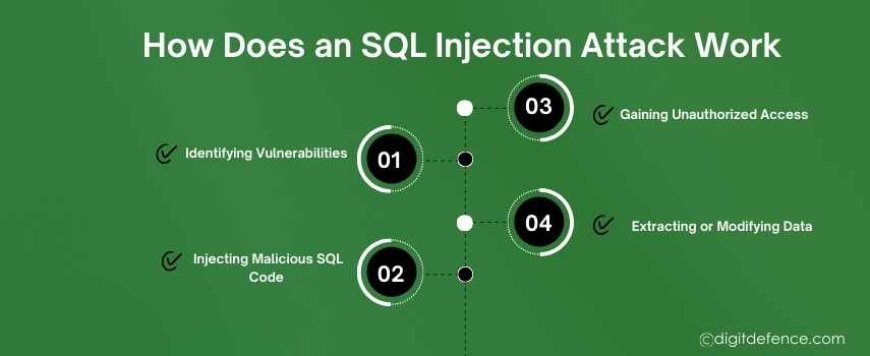
Step 1: Identifying Vulnerabilities
Hackers look for weak input fields where the website doesn’t sanitize or validate user input. These fields can include login forms, search bars, contact forms, or even URL parameters.
Step 2: Injecting Malicious SQL Code
Instead of entering legitimate information, an attacker inputs SQL commands that trick the database into executing unauthorized actions.
Step 3: Gaining Unauthorized Access
If the input field is not properly secured, the hacker’s SQL code manipulates the database to reveal sensitive data or bypass authentication.
Step 4: Extracting or Modifying Data
The attacker can now steal, edit, or delete information, compromise database security, and even escalate privileges to take full control of the system.
Types of SQL Injection Attacks
1. Classic SQL Injection (In-Band SQLi)
This is the most common type of SQL Injection Attack, where the hacker directly interacts with the database and retrieves information using the same channel.
2. Blind SQL Injection
In this method, hackers do not receive direct feedback from the database but can still extract database security risks by asking true or false questions through delays and response variations.
3. Time-Based SQL Injection
Attackers use SQL queries that force a delay in response time, confirming whether an SQL vulnerability exists.
4. Out-of-Band SQL Injection
This advanced SQL injection vulnerability uses external communication channels (DNS, HTTP requests) to exfiltrate data when direct responses are not possible.
How to Prevent SQL Injection Attacks
1. Use Prepared Statements & Parameterized Queries
Instead of concatenating user input, use prepared statements to prevent malicious SQL query manipulation.
2. Input Validation & Sanitization
-
Validate user inputs to allow only expected characters.
-
Use functions like html special chars() to prevent special character execution in queries.
3. Implement Web Application Firewalls (WAFs)
WAFs detect and block SQL Injection attempts in real-time, making them essential for web application security.
4. Limit Database Privileges
Restrict database user roles to prevent unauthorized actions by attackers.
5. Regular Security Audits & Penetration Testing
-
Conduct penetration testing to detect database security risks.
-
Perform regular security updates and patches to close vulnerabilities.
How SQL Injection Works
Understanding how SQL Injection attacks work helps in developing defense mechanisms to prevent them. Here’s how hackers exploit vulnerabilities in cybersecurity threats in databases:
1. Exploiting Unsecured Input Fields
When an application doesn’t properly validate input fields, attackers can inject malicious SQL code into login forms, contact forms, or even URL parameters to interact directly with the database.
2. Modifying SQL Queries
If a web application constructs SQL queries dynamically based on user input, an attacker can manipulate those queries to perform unauthorized actions like retrieving sensitive data, altering records, or even deleting entire databases.
3. Gaining Admin Access
A well-crafted SQL Injection attack can allow hackers to bypass authentication, gaining admin-level privileges and full control over the database security.
4. Executing Remote Commands
In some advanced hacking techniques using SQL, attackers can use SQL Injection to execute system-level commands, potentially taking over the entire server.
5. Covering Tracks
After successfully executing an attack, hackers often delete logs and traces of their activities to avoid detection, making it difficult for security teams to track the source of the breach.
Common Mistakes That Make Websites Vulnerable to SQL Injection
1. Not Validating User Input
Failing to filter or validate input fields makes it easier for attackers to inject SQL code into database queries.
2. Using Dynamic SQL Queries
Concatenating user inputs into SQL queries makes applications more prone to SQL Injection attacks.
3. Assigning Excessive Database Privileges
Allowing all users to access or modify critical database tables increases the risk of data breaches and SQL injection.
4. Not Using Web Application Firewalls (WAFs)
Without a WAF in place, malicious SQL Injection attempts go undetected, allowing hackers to infiltrate systems.
5. Ignoring Security Patches & Updates
Outdated database systems and unpatched vulnerabilities provide easy entry points for attackers.
Case Studies
Case Study1:
JPMorgan Chase, one of the largest financial institutions, was targeted by SQL Injection attacks attempting to steal customer financial data.
Challenges
-
Hackers exploited SQL vulnerabilities in login and transaction systems.
-
No real-time monitoring to detect SQL Injection attempts.
Solutions Implemented
-
Used prepared statements & parameterized queries to prevent attacks.
-
Deployed AI-based database security monitoring and Web Application Firewalls (WAFs).
Case Study2:
Amazon faced SQL Injection threats targeting customer login and checkout pages, risking data breaches and payment fraud.
Challenges
-
Attackers tried to extract stored credit card information using SQL query manipulation.
-
Needed a scalable security solution for millions of transactions.
Solutions Implemented
-
Implemented input validation and real-time anomaly detection.
-
Used AI-powered security monitoring to block SQL Injection attempts.
Understanding SQL Injection attacks is critical for anyone managing websites, applications, or databases. These attacks remain a major cybersecurity threat due to poor input validation, weak database security, and outdated coding practices. SQL Injection attacks can be prevented by implementing strong security practices such as input validation, prepared statements, firewalls, and frequent penetration testing. With proper web application security, businesses and developers can protect their data from cyber threats.