
How Penetration Testing Services Strengthens Network Security
Identify hidden threats with penetration testing! Strengthen your network security, prevent breaches, and build resilience against evolving cyberattacks today.

As a cybersecurity professional, I’ve seen how essential it is to stay ahead of potential threats. Cyber attacks are becoming more sophisticated, targeting vulnerabilities that even the most secure systems can overlook. That’s where penetration testing services come in. These simulated attacks mimic real-world scenarios, allowing businesses to uncover network weaknesses before malicious actors exploit them. For me, it’s not just a service it’s a proactive approach to protecting sensitive data and ensuring operational continuity.
When I work with organizations, I always emphasize that penetration testing is more than just finding flaws; it’s about building a stronger security framework. By identifying vulnerabilities, testing incident response capabilities, and offering actionable recommendations, penetration testing transforms a network’s defenses. It’s a major advancement that prevents breaches and instills confidence in the organization’s ability to withstand future attacks. With this strategy in place, they’ve taken a significant step toward safeguarding their digital assets.
What is penetration testing?
Penetration Testing Services are essential cybersecurity practices where skilled ethical hackers assess the security of a network, system, or application. By simulating potential attacks, they identify vulnerabilities that could be exploited by malicious actors. The primary goal of Penetration Testing Services is to evaluate the effectiveness of existing security measures and recommend actionable improvements to strengthen defenses.
Why Network Security is Critical
-
Increasing Cyber Threats: With the rise in ransomware, phishing, and advanced persistent threats (APTs), businesses face constant risks to their data and operations. Penetration Testing Services help mitigate these risks by identifying vulnerabilities before they can be exploited.
-
Compliance Requirements: Regulations like GDPR, PCI DSS, and HIPAA require organizations to maintain high-security standards. Penetration Testing Services ensure compliance and demonstrate due diligence.
-
Protecting Reputation: A single breach can lead to financial losses and irreparable damage to a company’s reputation. Regular Penetration Testing Services can prevent these incidents by proactively identifying risks.
Types of Penetration Testing
-
Network Penetration Testing
-
Focuses on assessing the security of internal and external networks.
-
Identifies vulnerabilities like open ports, weak encryption, or misconfigured firewalls.
-
Penetration Testing Services offer comprehensive insights into these weaknesses.
-
Web Application Penetration Testing
-
Evaluate the security of web-based applications.
-
Detects issues like SQL injection, cross-site scripting (XSS), and authentication flaws.
-
Wireless Penetration Testing
-
Analyzes the security of wireless networks.
-
Uncovers vulnerabilities like unauthorized access points or weak encryption protocols.
-
Social Engineering Testing
-
Simulates phishing attacks or other tactics to test employee awareness.
-
Physical Penetration Testing
-
Examines the security of physical locations to prevent unauthorized access to systems.
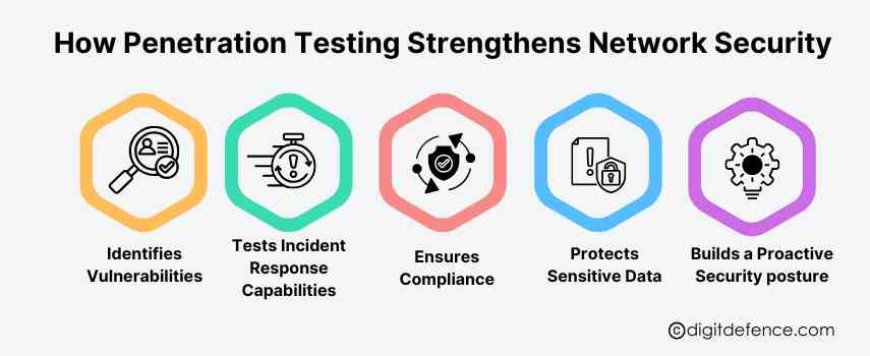
How Penetration Testing Strengthens Network Security
-
Identifies Vulnerabilities
-
Ethical hackers simulate real-world attack scenarios through Penetration Testing Services, discovering vulnerabilities that automated tools might miss.
-
Provides a comprehensive report of weaknesses and their potential impact.
-
Tests Incident Response Capabilities
-
It helps organizations evaluate how well their security team responds to threats.
-
Identifies gaps in detection, containment, and mitigation strategies, showcasing the value of Penetration Testing Services.
-
Ensures Compliance
-
Assist businesses in meeting regulatory and industry standards.
-
Demonstrates due diligence to stakeholders and auditors, ensuring Penetration Testing Services fulfill legal obligations.
-
Protects Sensitive Data
-
Safeguards customer information, intellectual property, and other critical assets.
-
Reduces the likelihood of data breaches and their associated costs through robust Penetration Testing Services.
-
Builds a Proactive Security posture
-
Shifts security strategies from reactive to proactive.
-
Provides actionable recommendations to prevent future attacks, proving the effectiveness of Penetration Testing Services.
Key Benefits of Penetration Testing Services
-
Enhanced Security Awareness: Educates teams about potential threats and how to mitigate them.
-
Cost-Effective: Prevents costly breaches by addressing vulnerabilities early with Penetration Testing Services.
-
Trust and Credibility: Demonstrates to clients and partners that security is a top priority.
-
Continuous Improvement: Regular testing keeps defenses updated against emerging threats.
Tools Used in Penetration Testing
-
Nmap: Scans networks for vulnerabilities.
-
Metasploit: Tests exploits and validates vulnerabilities.
-
Burp Suite: Assesses web application security.
-
Wireshark: Monitors network traffic for suspicious activities.
-
OWASP ZAP: Detects common web application vulnerabilities.
Steps Involved in Penetration Testing
-
Planning and Reconnaissance
-
Define goals and gather intelligence about the target.
-
Scanning
-
Use tools to identify entry points and vulnerabilities during Penetration Testing Services.
-
Exploitation
-
Attempt to exploit vulnerabilities to understand their impact.
-
Reporting
-
Provide detailed findings and recommendations for remediation through Penetration Testing Services.
-
Retesting
-
Verify that vulnerabilities have been fixed and security measures are effective.
Best Practices for Effective Penetration Testing Services
-
Regular Testing: Perform tests periodically to keep up with evolving threats.
-
Engage Certified Experts: Work with professionals certified in ethical hacking (e.g., CEH, OSCP).
-
Set Clear Objectives: Define what areas and systems need testing to optimize the value of Penetration Testing Services.
-
Integrate Findings: Act on recommendations to strengthen defenses.
Case Study 1: Target Corporation Data Breach
Overview:
In 2013, Target Corporation suffered a data breach, compromising approximately 40 million credit and debit card records. The attack highlighted significant vulnerabilities in their network security.
Implementation:
After the breach, Target utilized penetration testing services to identify weaknesses in its network infrastructure. Ethical hackers simulated real-world attack scenarios to uncover security gaps and test the effectiveness of their defenses.
Outcome:
-
Identified critical security vulnerabilities.
-
Implemented advanced malware detection systems and stricter access controls.
-
Strengthened network segmentation to reduce future risks.
Case Study 2: Home Depot Data Breach
Overview:
In 2014, Home Depot experienced a data breach that exposed 53 million email addresses and 56 million credit card numbers. The incident underscored vulnerabilities in their point-of-sale systems.
Implementation:
Home Depot conducted extensive penetration testing to assess its network and payment systems. The testing identified weak points in antivirus software and network monitoring, helping them evaluate their security protocols.
Outcome:
-
Upgraded security infrastructure and network monitoring.
-
Enhanced employee training on cybersecurity best practices.
-
Fortified defenses against future cyber threats.
For more information, the source link is here: LINK
Penetration testing is a cornerstone of modern network security. By simulating real-world attacks, businesses can uncover vulnerabilities, improve incident response, and build stronger defenses. Partnering with skilled penetration testing services ensures a proactive security posture, safeguarding critical assets and maintaining customer trust. In a world where cyber threats are ever-present, regular penetration testing is not just a best practice—it’s a necessity for long-term success and resilience.