
Penetration Testing for E-Commerce Businesses
Safeguard your e-commerce from hackers! Check out surprising tactics to secure your business and build customer trust. Act now to protect your success.

Having personal experience in the e-commerce industry, I understand the important role trust plays in retaining customers. But trust isn’t just about great products or stellar customer service; it’s also about safeguarding sensitive data. The thought of a hacker exploiting vulnerabilities in my platform once kept me up at night. What if my customers’ payment details were exposed? What if my site was brought down, costing me sales and reputation? I needed a way to ensure my business was secure.
That’s when I noticed penetration testing. It was innovative. Instead of waiting to see if my site could survive an attack, I proactively identified and resolved weaknesses before they became problems. Not only was the assurance that my e-commerce site was safe from online attacks invaluable to me, but it was also to my clients. This proactive approach empowered me to correct flaws and strengthen my defenses before they could be exploited. Today, I can operate my business with confidence, knowing I’ve done everything I can to protect my customers and my brand.
What is Penetration Testing?
Penetration testing simulates cyberattacks on your e-commerce platform to identify vulnerabilities before malicious actors exploit them. A team of ethical hackers uses real-world attack techniques to assess the security posture of your systems, providing actionable insights to fortify your defenses.
Why is Pen Testing Important for E-commerce Businesses?
-
Protect Sensitive Data: E-commerce platforms handle sensitive information such as customer credit card details, addresses, and personal information. Pen testing ensures this data remains secure.
-
Build Customer Trust: Demonstrating a commitment to security fosters customer trust and loyalty.
-
Meet Compliance Standards: Standards like PCI DSS and GDPR mandate stringent security measures. Pen testing helps ensure compliance, avoiding penalties and reputational damage.
-
Prevent Financial Losses: Cyberattacks can lead to significant financial losses due to fraud, fines, or downtime. Pen testing helps prevent such scenarios.
Types of Penetration Testing for E-Commerce
E-commerce businesses can benefit from various types of pen testing, including:
1. Network Penetration Testing
-
Evaluate the security of your network infrastructure.
-
Identifies vulnerabilities like misconfigured firewalls, open ports, and outdated software.
2. Web Application Penetration Testing
-
Focuses on the e-commerce website and associated web applications.
-
Targets vulnerabilities such as SQL injection, cross-site scripting (XSS), and authentication flaws.
3. Mobile Application Penetration Testing
-
Ensures the security of mobile apps used for shopping.
-
Tests for weaknesses in APIs, insecure data storage, and session management.
4. Cloud Security Testing
-
Examines cloud environments hosting e-commerce platforms.
-
Evaluates access control, data encryption, and configuration issues.
5. Social Engineering Testing
-
Assesses human vulnerabilities by simulating phishing attacks or impersonation attempts.
Steps in Conducting Penetration Testing
1. Planning and Scoping
-
Define the scope: Identify assets, applications, and networks to test.
-
Establish objectives: Align testing goals with business needs.
-
Obtain permissions: Ensure legal and ethical approval for testing.
2. Reconnaissance
-
Gather information about the target environment.
-
Use tools and techniques to identify potential entry points.
3. Exploitation
-
Attempt to exploit identified vulnerabilities.
-
Simulate real-world attack scenarios without causing harm.
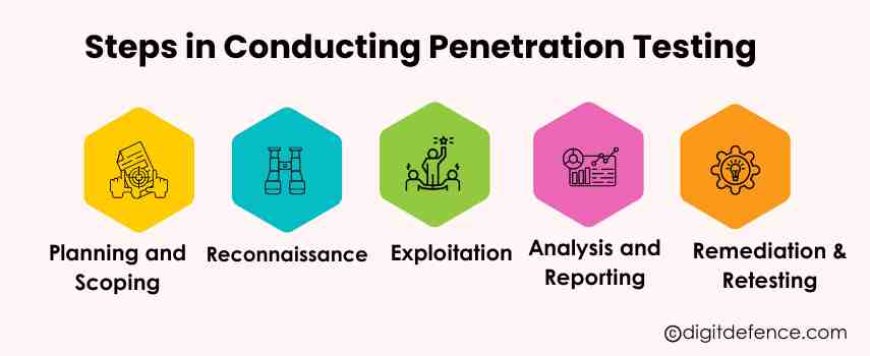
4. Analysis and Reporting
-
Document vulnerabilities, their severity, and potential impact.
-
Provide actionable recommendations for remediation.
5. Remediation and Retesting
-
Implement recommended fixes.
-
Retest to ensure vulnerabilities are resolved.
Best Practices for E-Commerce Pen Testing
-
Test Regularly: Conduct periodic tests to stay ahead of changing threats.
-
Engage Experts: Work with certified penetration testers with experience in e-commerce.
-
Prioritize Critical Assets: Focus on protecting customer data and payment systems.
-
Integrate with Development: Adopt DevSecOps practices to embed security into the development lifecycle.
-
Document and Act: Maintain detailed records of vulnerabilities and remediation actions.
Tools for E-Commerce Penetration Testing
Several tools can assist in penetration testing for e-commerce businesses:
-
Burp Suite: For web application security testing.
-
Nmap: To discover open ports and network vulnerabilities.
-
Metasploit: For exploiting vulnerabilities and testing defenses.
-
OWASP ZAP: To identify common web application security flaws.
-
Wireshark: For network traffic analysis.
Case Study 1: World of Books
Overview
World of Books, the UK's largest second-hand book retailer, operates multiple e-commerce platforms that process sensitive customer information. Recognizing the increasing risk of cyber threats, the company sought to strengthen its cybersecurity measures to protect customer trust and meet compliance standards.
Implementation
The company partnered with a CREST-accredited penetration testing provider to assess critical areas such as the checkout process, customer account systems, and session management protocols. Ethical hackers conducted tests to simulate real-world attacks, identifying vulnerabilities like insecure configurations and session flaws. Comprehensive reports provided actionable insights to address these issues.
Outcome
World of Books successfully mitigated identified vulnerabilities, ensuring robust security across its platforms. This proactive approach enhanced compliance with GDPR and other data protection laws while reinforcing customer trust. The company’s strengthened cybersecurity posture also protected its reputation and reduced the risk of costly breaches.
Case Study 2: Magento-Based E-Commerce Platforms
Overview
Magento, a leading e-commerce platform, experienced significant security challenges when vulnerabilities in its platform exposed businesses to potential cyberattacks. Issues such as cross-site scripting and remote code execution left sensitive customer data and server integrity at risk, putting Magento users in jeopardy.
Implementation
To address these threats, Magento-based businesses incorporated regular penetration testing as part of their security protocols. Ethical hackers were hired to identify weak points in web stores, focusing on areas like payment gateways and customer data storage. Alongside penetration testing, Magento issued regular security patches to address identified vulnerabilities.
Outcome
Magento-based businesses successfully protected their platforms by identifying and fixing vulnerabilities before they could be exploited. This proactive security measure safeguarded customer data, reduced downtime caused by attacks, and reinforced user trust in the platform. Regular testing and timely updates ensured a higher level of security resilience for all Magento-based stores.
Penetration testing is not just a security measure it’s a business enabler for e-commerce platforms. By identifying and mitigating vulnerabilities, businesses can protect sensitive data, comply with regulations, and maintain customer trust. Regular pen testing, combined with robust security practices, ensures resilience in the face of ever-evolving cyber threats.