
How Businesses Can Solve IoT Security Issues?
Learn how businesses can address security issues in the Internet of Things, manage IoT challenges, and strengthen cybersecurity in IoT systems.

Have you ever wondered what would happen if one small IoT device opened the door to your company’s entire data system? What if hackers used a smart sensor or CCTV camera to steal customer information?
The truth is, IoT is growing faster than security measures can keep up. Research shows that over 29 billion devices will be connected by 2030.
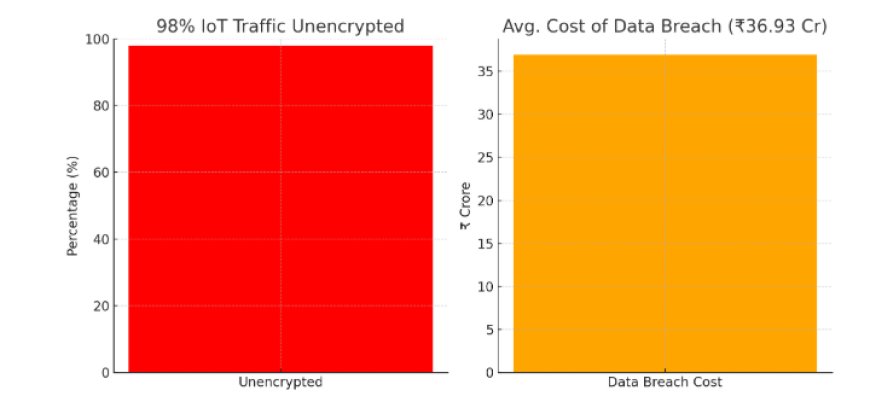
According to a report by Symantec, over 98% of IoT traffic is unencrypted, making it easy for attackers to steal data. According to IBM’s 2023 study, the global average cost of a data breach is ₹36.93 crore. Clearly, security issues in the Internet of Things are not minor flaws; they are high-risk business challenges.
Maersk, one of the world’s largest shipping companies, uses IoT-based systems for logistics and cargo tracking.
A cyberattack exploited weak IoT security, shutting down systems, delaying shipments, and costing the company millions.
Maersk rebuilt its IT infrastructure, improved IoT security protocols, and invested in stronger endpoint monitoring to prevent future breaches.
Understanding Security Issues in Internet of Things
The Internet of Things (IoT) refers to the interconnected network of smart devices, ranging from wearables and smart TVs to industrial sensors and healthcare monitoring equipment. While IoT boosts efficiency, lowers operational costs, and creates better user experiences, it also introduces critical Internet of Things security issues that businesses cannot ignore.
Some of the most common IoT challenges include:
-
Weak Authentication and Passwords – Many IoT devices ship with default login credentials, making them easy targets for hackers.
-
Lack of Regular Updates – Unlike computers or smartphones, IoT devices often lack automatic patching, leaving vulnerabilities open.
-
Data Privacy Risks – IoT devices collect vast amounts of personal and corporate data, which, if compromised, could lead to data theft.
-
Device Hijacking – Hackers can turn IoT devices into “zombies” to launch larger Distributed Denial-of-Service (DDoS) attacks.
-
Unsecured Networks – Many IoT devices communicate over weakly encrypted channels, exposing sensitive information.
Why Security Issues in IoT Are a Growing Business Risk
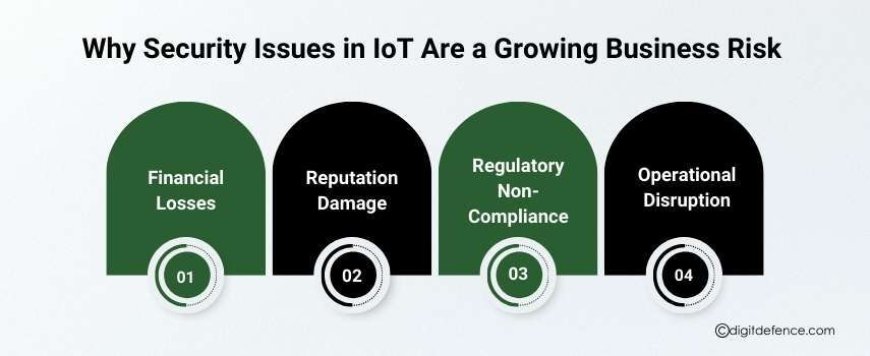
For businesses, IoT is no longer just about convenience; it powers smart factories, connected supply chains, customer experience platforms, and remote healthcare services. However, ignoring security issues in the Internet of Things can lead to:
-
Financial Losses: Breaches can result in millions in recovery costs, legal penalties, and lost revenue.
-
Reputation Damage: Customers lose trust in companies that fail to protect data.
-
Regulatory Non-Compliance: Industries such as healthcare and finance face strict rules on data protection.
-
Operational Disruption: Hacked devices can halt production lines or disable critical infrastructure.
In other words, businesses cannot treat IoT security as optional; it is a strategic necessity and a vital part of cybersecurity in IoT.
How Businesses Can Solve IoT Security Issues
The good news? Companies can proactively reduce risks by following proven strategies to address IoT challenges and improve cybersecurity in IoT systems.
-
Adopt Strong Authentication Mechanisms
Replace default usernames and passwords with strong, unique credentials. Where possible, implement multi-factor authentication (MFA) to add an extra layer of protection.
-
Encrypt Data at All Stages
Data should be encrypted in transit and at rest. End-to-end encryption ensures that even if attackers intercept the communication, the information remains unreadable.
-
Regularly Update and Patch Devices
Businesses must work with vendors that provide frequent firmware updates. A centralized patch management system can help keep all IoT devices up to date.
-
Segment IoT Networks
IoT devices should not be placed on the same network as core business operations. Using network segmentation ensures that even if one device is compromised, it doesn’t expose the entire system.
-
Implement Continuous Monitoring and Threat Detection
Modern IoT requires advanced monitoring tools powered by AI and machine learning. These tools detect unusual traffic patterns and stop attacks before they spread.
-
Conduct Regular Security Audits
Periodic penetration testing helps uncover hidden vulnerabilities. Businesses should also follow international IoT security standards like ISO/IEC 27001.
-
Educate Employees and Users
Employees handling IoT systems must understand the risks. Training staff to recognize phishing attempts, unauthorized access, or unusual device behavior is just as important as technical defenses.
How to Prevent Security Issues in the Internet of Things
While IoT opens doors to innovation, businesses must also close the gaps that hackers look for. Preventing Internet of Things security issues is possible with the right approach. Here are practical steps companies can take:
-
Strong Authentication and Password Policies
Replace factory-set default passwords with strong, unique credentials. Implement two-factor authentication wherever possible to reduce unauthorized access.
-
Regular Firmware and Software Updates
Ensure all IoT devices receive timely patches. If updates are not automated, create a scheduled maintenance cycle to check for new versions and fix vulnerabilities.
-
Encrypt Data at Every Stage
Data should be encrypted both in transit (while moving across networks) and at rest (when stored). This ensures sensitive information like customer details or operational data cannot be easily stolen.
-
Network Segmentation
Avoid connecting IoT devices directly to the main business network. Instead, create separate, secured networks so even if one device is compromised, the entire system isn’t at risk.
-
Continuous Monitoring and Threat Detection
Use intrusion detection systems (IDS) and IoT-specific monitoring tools to identify unusual activities in real time. Proactive monitoring helps stop attacks before they cause damage.
Future Trends in IoT Security for Businesses
As IoT adoption continues to accelerate, IoT security measures must also evolve to match growing risks. Businesses can’t rely on today’s methods alone; they must prepare for future IoT challenges. Here are the key future trends in IoT security that every organization should watch:
-
AI-Powered Threat Detection
Artificial Intelligence (AI) and Machine Learning (ML) are transforming how businesses respond to cyber threats. By analyzing massive volumes of IoT data in real-time, AI systems can detect unusual patterns and stop breaches before they escalate.
-
Blockchain for IoT Security
Blockchain ensures data integrity by creating decentralized, tamper-proof records. For IoT, this technology can secure communication between devices, making it harder for attackers to manipulate or intercept data.
-
Zero Trust Architecture
Instead of assuming devices or users are safe once inside the network, Zero Trust requires continuous verification. This trend is becoming critical for IoT, where thousands of connected devices need constant authentication.
-
Edge Computing Security
As more businesses shift to edge computing for faster data processing, securing the “edge” will become a top priority. This means stronger firewalls, encrypted gateways, and advanced monitoring systems near IoT endpoints.
-
Quantum-Resistant Encryption
With quantum computing on the horizon, current encryption methods may become obsolete. Businesses will soon adopt quantum-resistant algorithms to ensure long-term protection of IoT data.
The Internet of Things (IoT) is growing fast, and it is helping businesses work smarter, faster, and more efficiently. But with this growth also come risks. Hackers can target devices, steal sensitive data, or even disrupt entire systems if security is weak. That’s why solving security issues in Internet of Things is not just important, it’s necessary.
Want to secure your IoT systems and protect your business from risks?
Our experts can help you solve Internet of Things security issues, reduce IoT challenges, and improve cyber security in IoT with the right solutions.
Reach out to us today at [email protected] and let’s build a safer digital future together.