
The Future of Endpoint Detection and Response Solutions
Find out how modern Endpoint Detection and Response solutions tackle emerging threats, boost security, and empower your team faster than ever!

As a cybersecurity expert, I see the future of Endpoint Detection and Response (EDR) solutions as a significant area of focus in the ongoing battle against increasingly advanced cyber threats. In the past, EDR tools primarily aimed to detect and respond to threats on individual devices, but as cybercriminals grow more advanced and organizations expand their digital footprints across cloud environments, remote workforces, and mobile devices, the role of EDR is becoming far more complex. I anticipate that the future of EDR will center on a more holistic, integrated approach, leveraging AI and machine learning to predict, detect, and mitigate risks before they escalate into complete attacks.
From my perspective point, the next advancement of EDR solutions will involve greater automation, with the ability to not only respond to incidents in real time but also proactively hunt for potential threats. As organizations continue to adopt diverse IT infrastructures, I foresee EDR tools becoming increasingly interconnected with other security systems, such as SIEM and SOAR, to create a unified, intelligent security ecosystem. With advancements in AI and data analytics, these next-generation EDR solutions will empower cybersecurity teams to stay ahead of threats, ensuring more efficient and effective protection for businesses across the globe.
What is Endpoint Detection and Response (EDR)?
Endpoint Detection and Response (EDR) is a cybersecurity solution designed to detect, investigate, and respond to threats targeting endpoints, such as laptops, desktops, servers, and mobile devices. Unlike traditional antivirus software, EDR provides continuous monitoring and analysis of endpoint activity, enabling organizations to:
-
Detect potential threats in real time.
-
Investigate suspicious behavior using detailed forensic data.
-
Respond to incidents quickly and effectively.
The primary goal of EDR is to enhance an organization’s ability to protect against advanced persistent threats (APTs), malware, ransomware, and other sophisticated cyberattacks.
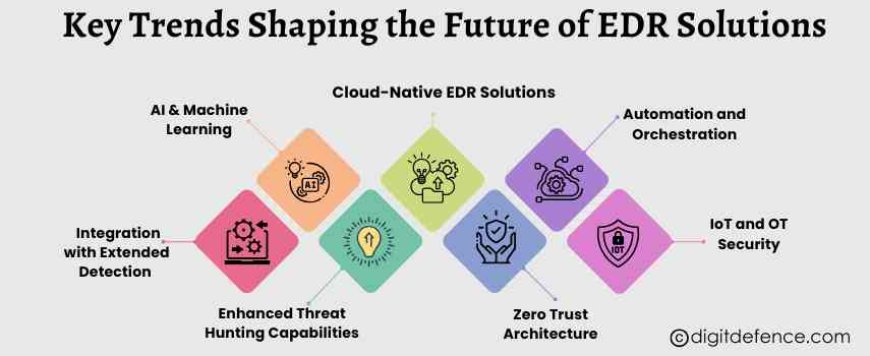
Key Trends Shaping the Future of EDR Solutions
As the cybersecurity landscape evolves, EDR solutions are undergoing significant advancements. Here are the key trends shaping their future:
1. Integration with Extended Detection and Response (XDR)
While EDR focuses on endpoint protection, Extended Detection and Response (XDR) expands the scope to include other security layers such as email, network, and cloud environments. The integration of EDR with XDR provides a holistic view of an organization’s security posture. This trend ensures that security teams can:
-
Correlate data across multiple layers for better threat detection.
-
Reduce the time taken to identify and respond to incidents.
-
Simplify security operations with unified platforms.
2. Artificial Intelligence (AI) and Machine Learning (ML)
AI and ML are revolutionizing the cybersecurity industry, and EDR solutions are no exception. Future EDR systems will increasingly rely on AI-driven analytics to:
-
Predict and prevent threats before they manifest.
-
Automate threat detection and response processes.
-
Identify patterns and anomalies that indicate malicious activity.
By leveraging AI and ML, Endpoint Detection and Response solutions will become smarter, faster, and more accurate, reducing the burden on human analysts.
3. Enhanced Threat Hunting Capabilities
Proactive threat hunting is becoming a critical component of modern cybersecurity. EDR tools of the future will offer advanced threat-hunting capabilities, enabling security teams to:
-
Search for hidden threats within the network.
-
Identify and mitigate potential vulnerabilities.
-
Gain actionable insights from endpoint telemetry.
With these capabilities, organizations can stay one step ahead of attackers and minimize the risk of breaches.
4. Cloud-Native EDR Solutions
As businesses migrate to the cloud, EDR solutions are following suit. Cloud-native EDR platforms offer several advantages over traditional on-premises systems, including:
-
Scalability to handle growing data volumes.
-
Faster deployment and updates.
-
Reduced infrastructure costs.
Cloud-native Endpoint Detection and Response solutions also facilitate seamless integration with cloud workloads, ensuring comprehensive protection across hybrid and multi-cloud environments.
5. Zero Trust Architecture
The adoption of zero-trust principles is transforming the way organizations approach cybersecurity. Future EDR solutions will align with Zero Trust strategies by:
-
Continuously verifying user and device identities.
-
Enforcing strict access controls.
-
Monitoring endpoint behavior in real-time to detect deviations.
By integrating Zero Trust principles, EDR solutions can provide stronger protection against insider threats and lateral movement within networks.
6. Automation and Orchestration
To address the shortage of cybersecurity professionals and the growing complexity of threats, automation is becoming a key feature of EDR solutions. Automated workflows and orchestration tools will enable security teams to:
-
Respond to incidents with minimal manual intervention.
-
Streamline investigation processes.
-
Enhance collaboration between security tools and platforms.
Automation not only improves efficiency but also reduces the chances of human error during critical incident response activities.
7. IoT and OT Security
The proliferation of Internet of Things (IoT) devices and Operational Technology (OT) systems has expanded the attack surface for organizations. Future EDR solutions will evolve to:
-
Provide visibility into IoT and OT environments.
-
Detect threats targeting connected devices.
-
Secure industrial control systems (ICS) from cyberattacks.
This evolution is critical as IoT and OT become integral to industries such as manufacturing, healthcare, and energy.
Benefits of Advanced EDR Solutions
The advancements in Endpoint Detection and Response solutions will bring numerous benefits to organizations, including:
-
Improved Threat Visibility: Comprehensive monitoring and analytics provide deep insights into endpoint activity.
-
Faster Incident Response: Automation and real-time alerts enable rapid response to threats.
-
Reduced Costs: Efficient EDR solutions minimize the financial impact of breaches and reduce operational costs.
-
Enhanced Compliance: Advanced EDR tools help organizations meet regulatory requirements by providing detailed audit trails and reports.
-
Better Scalability: Cloud-native and AI-powered EDR systems can scale to meet the demands of growing organizations.
Challenges and Solutions
Despite their advantages, Endpoint Detection and Response solutions face several challenges. Addressing these challenges is essential for ensuring their continued effectiveness.
1. Overwhelming Alerts
Security teams often struggle with the volume of alerts generated by EDR systems. To address this, future solutions will:
-
Use AI to prioritize alerts based on severity and context.
-
Implement advanced filtering mechanisms to reduce noise.
-
Provide intuitive dashboards for better alert management.
2. Lack of Skilled Personnel
The global shortage of cybersecurity professionals makes it difficult for organizations to manage EDR systems effectively. This challenge can be mitigated by:
-
Automating routine tasks to free up analysts for critical activities.
-
Offering user-friendly interfaces that simplify operations.
-
Providing training and certifications to upskill existing staff.
3. Sophisticated Threats
As cyber threats evolve, EDR solutions must stay ahead of attackers. This requires:
-
Continuous updates to threat intelligence databases.
-
Integration with advanced technologies such as AI and blockchain.
-
Collaboration with global cybersecurity communities to share insights.
The Role of EDR in a Comprehensive Cybersecurity Strategy
While Endpoint Detection and Response solutions play a critical role in securing endpoints, they should not operate in isolation. A robust cybersecurity strategy integrates EDR with other tools and practices, such as:
-
Firewall and Network Security: To protect network traffic and prevent unauthorized access.
-
Data Encryption: To secure sensitive information both in transit and at rest.
-
Security Awareness Training: To educate employees about recognizing and avoiding threats.
-
Incident Response Plans: To ensure a structured approach to managing breaches.
By combining these elements, organizations can create a layered defense strategy that enhances the effectiveness of their Endpoint Detection and Response solutions.
Case Study 1: Nuspire and Global Enterprise Franchise Security
Overview:
A global company with many franchise locations needed a way to secure its widespread endpoints. With limited control over each franchise’s network, it was vulnerable to cyber threats.
Implementation:
The company worked with Nuspire to implement an Endpoint Detection and Response (EDR) solution. This allowed them to monitor activities like file access, network communication, and application behavior across all locations.
Outcome:
The EDR solution provided better visibility into endpoint activities, enabling faster detection of threats and more effective responses. It improved overall security without needing to increase internal IT resources.
For more information, source link: LINK
Case Study 2: Bitdefender and the Equifax Breach Analysis
Overview:
After the 2017 Equifax breach, it was clear that a stronger approach to endpoint security was necessary. The breach was caused by an unpatched vulnerability, exposing millions of personal records.
Implementation:
Bitdefender recommended using its Endpoint Protection and Detection solution, which includes real-time monitoring, threat detection, and rapid response capabilities to prevent similar attacks.
Outcome:
Using Bitdefender’s EDR solution, organizations improved their ability to detect and respond to threats quickly. This proactive approach reduced risk and helped avoid similar breaches in the future.
For more information, source link: LINK
The future of Endpoint Detection and Response solutions is promising, with advancements in AI, automation, and cloud technologies driving their evolution. As cyber threats continue to grow in complexity, EDR tools will play an increasingly vital role in protecting organizations’ endpoints and overall security posture. By embracing the latest trends and innovations, organizations can ensure that their Endpoint Detection and Response solutions remain effective, scalable, and resilient in the face of emerging challenges.