How One Multivector Attack Can Break Your System in “Minutes”
Learn how a Multivector Attack can break your system in minutes and how to protect your business with simple, effective cyber security practices.

The moment no business wants to face - when everything unexpectedly shuts down
The website freezes.
The payment gateway goes offline.
Teams start calling, asking why they can’t log in.
Customers begin reporting errors.
And just like that, a normal working day turns into a race against time.
For many businesses, this moment begins with something they don’t even understand clearly, a Multivector Attack.
It doesn’t give you hours.
It doesn’t give you warnings.
In many cases, it breaks your system within minutes.
But why does this type of attack spread so fast?
Why can it shut down even well-protected systems?
And why are so many companies still unprepared?
Understand the growing risk of Multivector Attacks, what’s driving their rise, and how to safeguard your business in advance
The Day Everything Went Wrong - A Real Story
Imagine this.
A small tech company, NexoraTech, starts getting complaints from customers
“Your website is slow.”
“Your login isn’t loading.”
“Is your server down?”
Inside the office, confusion grows.
The team checks the server - everything seems normal.
The firewall is active.
Antivirus is running.
Nothing looks wrong.
But within five minutes, their email crashes.
Then their cloud storage stops responding.
Then their whole internal network gets locked out.
By the time they figure out what is happening, a Multivector Attack has already hit multiple points of their system:
-
Their website
-
Their internal network
-
Their customer database
-
Their cloud application
-
Even their backup server
This is why the name “Multivector” matters, the attack comes from different directions at the same time.
This is also why it destroys systems so quickly.
So, What Exactly Is a Multivector Attack? (Easy Explanation)
A Multivector Attack means hackers use many attack methods at once.
Think of it like this:
-
One attacker tries to flood your server.
-
Another tries to steal your admin password.
-
Another pushes fake login pages.
-
Another installs malware.
-
Another tries to break the firewall.
They all hit you at the same time.
This is why a Multivector Attack is so dangerous → your security system is forced to fight multiple battles at once.
If even one weak point breaks, the attackers get in.
Why These Attacks Break Systems in Minutes
A normal cyber attacks focuses on one entry point.
Your firewall blocks it.
Your antivirus warns you.
Your team has time to respond.
But with a Multivector Attack, things move much faster.
Here’s why:
1. It overloads your system instantly
Your server gets too many requests at the same time.
This slows everything down or shuts it down.
2. It confuses your security tools
Your firewall can’t decide which attack is the real one.
While it tries to analyze one, another enters.
3. It targets your weakest point
Even if 9 layers are strong, the attackers only need one weak layer to win.
4. It distracts your team
While your team tries to fix the website, the attackers move to your cloud or database.
5. It spreads quickly
Once inside, it can jump to every connected system.
In short:
A Multivector Attack is fast because it forces your security to fight on many fronts at once, and humans simply cannot keep up.
Why Are Multivector Attacks Increasing Today?
Because businesses today depend on:
-
cloud apps
-
emails
-
mobile devices
-
customer portals
-
online payments
-
remote access
-
third-party tools
This means more doors.
More connections.
More weak points.
Hackers know this.
They use a Multivector Attack to strike every entry point at the same time, making it very hard for businesses to defend themselves.
A Quick Look at the Numbers
Here are simple, understandable stats about modern attacks:
- 72% of attacks now use more than one method
- 50% of small businesses take hours to detect an attack
- 60% of companies shut down for at least one day after a major breach
- Cyber losses grew 200% in the last three years
This shows how serious these attacks are and how fast they are growing.
“We Thought We Were Safe”
Most businesses don’t fear what they understand.
They fear what they don’t see coming.
And that is exactly what happens with a Multivector Attack.
Companies usually say:
-
“We have antivirus.”
-
“We have a firewall.”
-
“We are too small to be targeted.”
-
“Hackers only attack big companies.”
But reality is very different.
Small and mid-size businesses are the easiest targets because they have weaker security, but still store valuable data.
This is why a Multivector Attack breaks through them so quickly.
The Emotional Truth No One Talks About
A cyberattack isn’t just a technical issue.
It affects:
-
your work
-
your reputation
-
your customers
-
your trust
-
your income
For business owners, the fear is real:
“What if everything I built disappears?”
“What if customers stop trusting us?”
“What if we lose our data forever?”
This fear is understandable - and this is why learning about a Multivector Attack is so important.
The goal isn’t to scare you.
The goal is to empower you before the damage happens.
How to Protect Your Business From a Multivector Attack
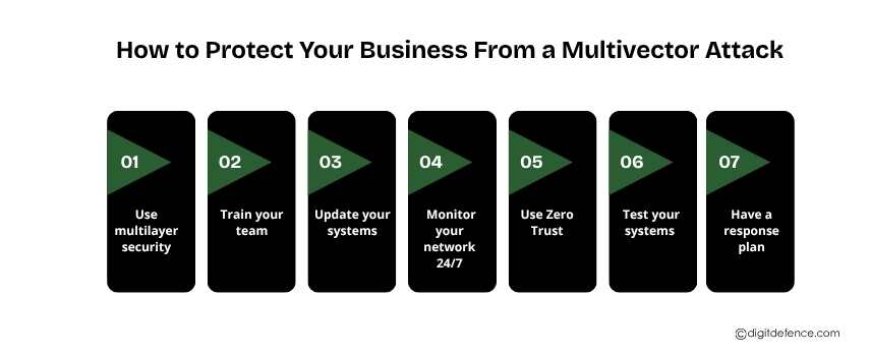
Here are simple, clear steps:
1. Use multilayer security
One tool is not enough.
You need layers like:
-
firewalls
-
antivirus
-
MFA
-
data backup
-
EDR/XDR tools
2. Train your team
Most attacks enter through human mistakes (wrong click, wrong link).
3. Update your systems
Old software = easy entry.
4. Monitor your network 24/7
Attacks often happen late at night when no one is watching.
5. Use Zero Trust
Never trust a device or user by default.
6. Test your systems
Run regular security checks.
7. Have a response plan
So your team knows exactly what to do.
A Warning Sign You Can’t Afford to Miss
Your competitors are upgrading their security.
Companies are training their staff.
Businesses are investing in stronger protection.
The question is:
Will you be prepared before the next attack or after?
Most people take action only after something goes wrong.
But the smarter choice is to learn now.
And that decision can protect your business, your work, your customers, and your future.
Your Defence Starts With Awareness
A Multivector Attack is fast, aggressive, and designed to break systems in minutes.
But the good news is:
Awareness is the first step to protection.
When you understand how attacks work, you make smarter choices.
You prepare stronger systems.
You avoid panic.
You grow with confidence.
Security is not only about tools.
It’s about the knowledge you carry with you.
If you want to learn how to protect yourself, your team, and your business from modern threats - start now.
Strengthen Your Business Cyber Defence
If you want to keep your systems safe, avoid problems, and stay ahead of threats like a Multivector Attack,
Digitdefence is here to help your business.
We give you strong protection, clear guidance, and simple security steps so your business can run safely and with confidence.