Upgrading Security? Don’t Skip Information Assurance
Information Assurance strengthens cybersecurity by ensuring data integrity, confidentiality, and trust across systems for reliable business protection.

Every business wants to stay one step ahead of cyber threats.
They invest in stronger firewalls, move to cloud-based security, and train their teams to spot phishing attempts. Yet, even after all this effort, data breaches still happen.
Why does this keep happening? Because upgrading security tools isn’t enough. Real protection comes from trust - and that’s where Information Assurance (IA) plays a key role.
Information Assurance isn’t just another layer of defense. It’s what makes sure your data stays confidential, accurate, and dependable, even after your cybersecurity tools have done their job.
Think of it this way - cybersecurity protects the system, while Information Assurance protects what’s inside it, your information, reputation, and customer trust.
Understanding Information Assurance (IA)
Information Assurance (IA) is the discipline of managing and protecting information systems so that data remains confidential, accurate, available, and trustworthy at all times.
While cybersecurity focuses on defense keeping attackers out IA focuses on resilience ensuring that even when systems are tested, data remains dependable and secure.
The core purpose of IA is to build and maintain trust in information systems. That means protecting data before, during, and after any potential incident.
In business terms, IA ensures that:
-
Sensitive information stays protected from unauthorized users (confidentiality).
-
Data isn’t altered, lost, or corrupted (integrity).
-
Systems and networks are always available when needed (availability).
-
Every access or transaction can be verified and traced (authentication and non-repudiation).
This framework ensures your business doesn’t just avoid threats , it keeps running confidently, even in a challenging digital environment.
The Five Pillars of Information Assurance
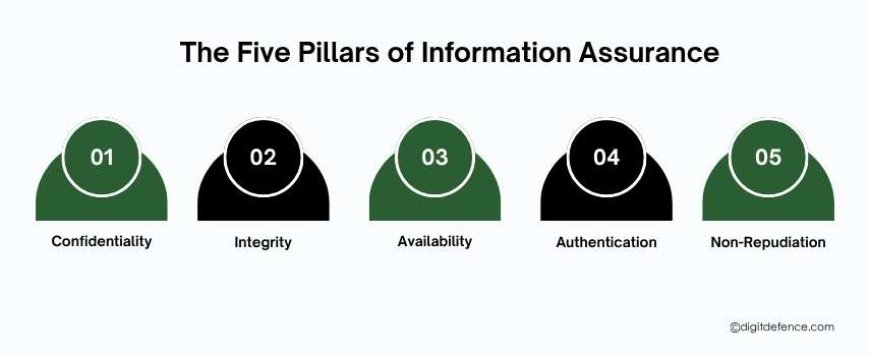
To truly grasp IA, let’s look at its five key pillars - the foundation of reliable data protection.
-
Confidentiality
Ensures that only authorized users can view or handle information.
Example: Role-based access controls or data encryption that prevents outside access.
-
Integrity
Protects data from unauthorized modification or corruption.
Example: Digital signatures or checksums verifying that data hasn’t been tampered with.
-
Availability
Keeps systems operational and data accessible when required.
Example: Cloud backups, redundancy, and disaster recovery planning.
-
Authentication
Confirms that users and systems are who they claim to be.
Example: Multi-factor authentication or digital certificates for secure logins.
-
Non-Repudiation
Ensures users cannot deny their actions.
Example: Logging and timestamping critical operations or file access.
When these five principles work together, your business achieves data assurance, not just network security.
When these five principles work together, your business achieves data assurance, not just network security.
Why Information Assurance Matters More Today
Information Assurance prevents that by bridging three critical gaps:
-
Between technology and policy - ensuring all tools follow clear governance.
-
Between people and systems - minimizing risks from human error.
-
Between compliance and action - verifying that security rules are actually being followed.
How IA Strengthens Modern Cybersecurity
Information Assurance doesn’t replace cybersecurity - it completes it.
Here’s how it enhances your overall defense strategy:
-
Adds Governance to Technology
IA ensures that every tool and process aligns with defined security policies, creating consistency across departments.
-
Improves Risk Visibility
Continuous auditing and reporting help identify potential issues before they become breaches.
-
Supports Compliance
IA practices align with standards like ISO 27001, GDPR, and HIPAA - protecting your business from regulatory penalties.
-
Builds Stakeholder Confidence
Transparent assurance reports and data governance instill trust among customers, investors, and partners.
-
Prepares for Incident Recovery
IA focuses not just on preventing incidents but on restoring operations quickly when they occur.
Integrating IA into Your Security Framework
Adding IA doesn’t require rebuilding your infrastructure.
It’s about enhancing what you already have with accountability and continuous improvement.
-
Assess Current Risks and Gaps
Conduct a risk assessment to identify where assurance is missing - like outdated access policies, weak data classification, or incomplete backups.
-
Develop an IA Policy
Create a clear framework covering data use, user roles, and incident management. Define who is responsible for what.
-
Adopt Continuous Monitoring
Use monitoring tools to verify system health, detect anomalies, and maintain data integrity in real time.
-
Train Teams Consistently
Employees must understand not just what to protect but why.
Regular awareness sessions build a security-first culture.
-
Run Regular Audits
Internal and third-party audits keep systems honest and help refine processes before external threats exploit them.
-
Align IA with Business Objectives
Assurance shouldn’t slow you down - it should enable secure innovation.
When IA is built into project planning, new initiatives launch safer and faster.
Common Mistakes Companies Make Without IA
Even companies with advanced cybersecurity fall into these traps:
-
Focusing Only on External Threats — ignoring insider risks and process flaws.
-
Treating Security as IT’s Job Alone — instead of a shared organizational responsibility.
-
Skipping Audits and Policy Reviews — assuming “no news” means safety.
-
Collecting Data Without Governance — leading to integrity or compliance issues later.
Without IA, organizations may have high-tech defenses but no guarantee that their data is accurate, available, or trustworthy.
The Future of Information Assurance
As technologies like AI, IoT, and 5G reshape business, the attack surface widens dramatically.
Data no longer lives in one place - it moves across clouds, devices, and global networks.
Future-ready organizations are already evolving IA practices by:
-
Integrating AI-driven risk analytics to detect anomalies faster.
-
Implementing Zero-Trust frameworks for tighter authentication.
-
Automating compliance validation using real-time dashboards.
These aren’t trends, they’re necessities.
Because as automation increases, assurance becomes the new foundation of digital trust.
Why CIOs and CISOs Prioritize IA
Many leading security executives now see Information Assurance as a strategic enabler, not just a compliance checkbox.
-
CIOs view IA as critical to digital transformation — ensuring innovation doesn’t outpace safety.
-
CISOs depend on IA frameworks for measurable accountability and reporting accuracy.
-
Compliance Officers leverage IA to demonstrate governance during audits.
Organizations with mature IA programs report fewer incidents, faster recovery times, and higher customer retention rates - proving that trust directly impacts growth.
Secure Is Good, Assured Is Better
Upgrading security systems is essential - but it’s only half the battle.
Without Information Assurance, those systems operate in isolation, leaving unseen gaps that attackers can exploit.
Think of IA as the bridge between technology and trust.
It ensures that your defenses don’t just exist - they work, adapt, and verify continuously.
So before your next upgrade cycle, ask one question:
“Are we protecting our data - or just assuming it’s safe?”
By embedding Information Assurance into your cybersecurity strategy, you strengthen resilience, compliance, and confidence - three assets no business can afford to lose.
Because in the end, true security isn’t about stronger walls , it’s about smarter assurance.