Why Every Business Needs a Cyber Security Company Today
Learn why partnering with a cyber security company is essential for protecting your business from data breaches, cyber threats, and compliance risks.

Cyber threats are becoming more advanced, frequent, and devastating. As a cybersecurity specialist, it’s hard to ignore the growing risks of cyberattacks. From data breaches to ransomware attacks, the stakes are higher than ever. Even a single breach can have severe consequences, not only in terms of financial losses but also in the damage it can do to your brand’s reputation and customer trust. This is why I believe that every business, regardless of its size, needs a specialized cyber security company to safeguard its digital assets. It's no longer a luxury or a "nice-to-have"; it’s a necessity for survival in today’s competitive and highly connected marketplace.
When I first considered investing in a cybersecurity partner for my business, it became clear that the constantly changing nature of cyber threats requires a level of expertise that goes beyond what an in-house IT team can handle. Cybersecurity companies bring a deep understanding of the latest threats, tools, and strategies, enabling them to provide comprehensive protection tailored to my business’s specific needs. They offer proactive measures, such as continuous monitoring, vulnerability assessments, and incident response plans, which are essential for minimizing risks and ensuring business continuity. With a trusted cybersecurity partner, I can focus on growing my business, knowing that critical data and systems are protected from malicious actors.
What is cybersecurity?
Cybersecurity is the practice of defending systems, networks, and programs from digital attacks, damage, or unauthorized access. These attacks can range from data theft to ransomware attacks and everything in between. Cybersecurity is crucial for protecting business data, maintaining regulatory compliance, ensuring operational continuity, and safeguarding customer trust.
Why Every Business Needs Cybersecurity Services
1. Protecting Sensitive Business Data
Every business holds valuable data, from customer information and financial records to trade secrets and intellectual property. If such data falls into the wrong hands due to a cyberattack, it can lead to devastating consequences, such as financial loss, reputational damage, and legal consequences. A cyber security company helps safeguard your sensitive data by protecting against common attacks like phishing, malware, and ransomware.
2. Preventing Data Breaches
A data breach is one of the most common and damaging cybercrimes businesses face today. In fact, according to the Verizon Data Breach Investigations Report, the vast majority of data breaches are a result of human error or malicious attacks. By hiring a cybersecurity company, businesses can implement proactive measures such as encryption, firewalls, and multi-factor authentication to prevent unauthorized access to sensitive systems.
3. Reducing Financial Risks
Cyberattacks not only lead to financial losses through stolen funds, but businesses may also face regulatory fines and litigation costs in the aftermath of a breach. The global cost of cybercrime is expected to reach $10.5 trillion annually by 2025, according to Cybersecurity Ventures. With these kinds of financial threats looming, it becomes even more critical to invest in a cyber security company to proactively defend your assets, prevent downtime, and avoid the high cost of a breach.
4. Ensuring Regulatory Compliance
Many industries, such as healthcare, finance, and retail, are governed by strict compliance regulations that mandate businesses to protect sensitive data. GDPR (General Data Protection Regulation), HIPAA (Health Insurance Portability and Accountability Act), and PCI-DSS (Payment Card Industry Data Security Standard) are just a few examples of compliance frameworks designed to ensure businesses safeguard customer data and adhere to best security practices. A cyber security company can help ensure that your business is compliant with these regulations, reducing the risk of penalties and reputational damage.
5. Building Customer Trust
In an environment where data breaches and cyberattacks are rampant, customers are more concerned than ever about the security of their personal information. By partnering with a cybersecurity firm, businesses can implement secure data storage practices, encryption, and secure payment gateways to protect customer data. Having strong cybersecurity measures in place builds trust with customers, demonstrating that you take their privacy seriously.
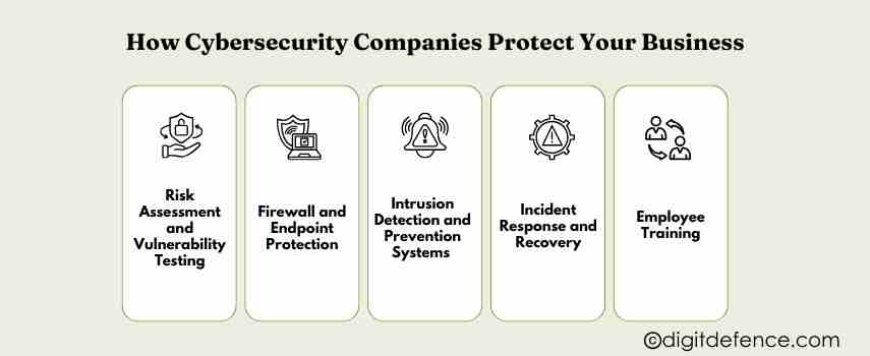
How Cybersecurity Companies Protect Your Business
A cyber security company employs a range of services to protect your business. These may include:
-
Risk Assessment and Vulnerability Testing: Evaluating existing systems to identify potential weaknesses and recommend improvements.
-
Firewall and Endpoint Protection: Ensuring robust network defenses to block unauthorized access and protect endpoints like devices and servers.
-
Intrusion Detection and Prevention Systems (IDPS): Detecting malicious activity on your network and preventing unauthorized access.
-
Incident Response and Recovery: Responding to security breaches in real time and helping recover compromised systems.
-
Employee Training: Teaching employees how to recognize phishing attempts, use strong passwords, and follow security best practices.
Key Benefits of Partnering with a Cybersecurity Company
-
Expertise: Cybersecurity companies employ skilled professionals with specialized knowledge and experience in protecting businesses from evolving cyber threats.
-
Cost-Effectiveness: While hiring an in-house cybersecurity team can be expensive, outsourcing to a cyber security company provides cost-effective solutions tailored to your business needs.
-
Access to Advanced Technology: Cybersecurity firms use the latest tools, software, and technologies that may be too expensive or complex for individual businesses to implement.
Case Study 1: Yahoo - The Largest Data Breach in History
Overview:
In 2013 and 2014, Yahoo suffered one of the largest data breaches in history, affecting 3 billion user accounts. The breach exposed sensitive data like email addresses, names, and even security questions. The breach went undetected for years and wasn't disclosed until 2016. It was eventually traced back to a state-sponsored attack that exploited security weaknesses in Yahoo’s systems.
Implementation:
To address the breach, Yahoo undertook several corrective actions, including:
-
Implementing advanced encryption for user data.
-
Requiring two-factor authentication for users.
-
Conducting a thorough security audit to identify and patch vulnerabilities.
Yahoo also revamped its third-party risk management to ensure that external partners adhered to stricter security standards.
Outcome:
Despite these efforts, the breach had lasting consequences, costing Yahoo over $350 million in the sale of its business to Verizon. The breach severely impacted its reputation and highlighted the need for stronger data protection and quicker response times to potential threats. Yahoo's failure to detect and mitigate the breach earlier led to regulatory scrutiny and loss of customer trust.
Case Study 2: Facebook - Cambridge Analytica Scandal
Overview:
In 2018, Facebook was embroiled in the Cambridge Analytica scandal, where the data of 87 million users was harvested without consent. The data was used for political profiling, and Facebook's failure to secure user data led to widespread criticism of its data privacy practices.
Implementation:
Facebook responded by taking several actions to improve data security:
-
Tightened API access to third-party applications.
-
Implemented privacy-focused features such as stronger user consent requirements.
-
Began a comprehensive audit of third-party apps to ensure they complied with stricter privacy policies.
Facebook also began to focus on data minimization and transparency in how user data is handled.
Outcome:
The breach resulted in a $5 billion fine from the FTC, and the company’s reputation took a major hit. Facebook lost user trust, and its stock prices suffered. The scandal underscored the importance of third-party risk management and compliance with privacy laws. Facebook's increased focus on data privacy and improved user consent mechanisms helped rebuild some trust, but the scandal remains a powerful reminder of the reputation-damaging consequences of mishandling user data.
Cybersecurity is no longer optional it's essential for the survival and growth of your business. A cybersecurity company offers the expertise, technology, and proactive measures needed to protect your business from evolving cyber threats. By safeguarding sensitive data, ensuring compliance, preventing breaches, and building customer trust, cybersecurity services provide long-term value for businesses across industries. In a world where the consequences of cyberattacks are increasingly severe, partnering with a cybersecurity company is one of the most important investments you can make to protect your business, assets, and reputation.