
How to Protect Your Business from AI Threats?
AI threats are rising fast. Protect your business now! Learn smart strategies to defend against AI-driven attacks and stay ahead of cybercriminals today.

Do you know that there are more and more risks that artificial intelligence poses to your business?
Do you know how to protect your business from changing artificial intelligence risks before significant harm happens? What you must understand is that new AI technologies are developing quickly, and businesses must always be aware of security risks as they protect their assets, data, and company reputation.
Recent studies show that 30% of cyberattacks now leverage AI-based tools, and nearly 60% of businesses have experienced AI-related incidents in the past two years. Compounded with that, the projected cost of global cybercrime driven by AI is expected to hit ₹8.2 lakh crore by 2027, increasing the urgency for businesses to directly confront threats posed by AI.

An intriguing real-world case is Darktrace, a cybersecurity firm that was able to stop AI-based phishing attacks aimed at Fortune 500 companies. Darktrace, a leader in AI cybersecurity, effectively stopped multiple Fortune 500 companies from becoming targets of AI-enhanced phishing campaigns. The attackers utilized AI to create new classes of sophisticated emails that helped them bypass traditional detection filtering. They even created targeted attacks aimed at accessing high-value employees at the Fortune 500 companies.
Utilizing Darktrace's AI-enhanced detection, suspicious email patterns were quickly identified, and threats were removed before any data could be lost. This preemption highlights the beneficial aspects of using AI not strictly as a threat but as a defense against threats from AI.
Understanding Artificial Intelligence Threats
An artificial intelligence threat refers to risks and vulnerabilities introduced by AI technologies when exploited maliciously. While AI offers tremendous benefits, cybercriminals have also adopted AI to enhance the sophistication and scale of their attacks. AI threats can include automated phishing, deepfake fraud, autonomous malware, and AI-driven network intrusions.
The complexity and speed of AI-powered attacks make them difficult to detect and counter using conventional security measures. Businesses must understand the nature of these threats to build resilient defenses.
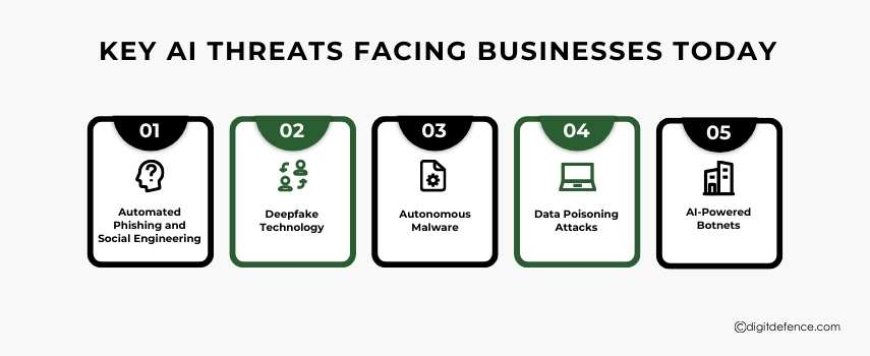
Key AI Threats Facing Businesses Today
-
Automated Phishing and Social Engineering: AI can create personalized, convincing phishing messages that trick employees and customers.
-
Deepfake Technology: AI-generated fake videos or audio can be used to manipulate stakeholders or conduct fraud.
-
Autonomous Malware: AI-enabled malware can adapt and evolve, evading traditional antivirus and intrusion detection systems.
-
Data Poisoning Attacks: AI models themselves can be compromised by feeding them manipulated data, causing flawed decision-making.
-
AI-Powered Botnets: Networks of AI-controlled bots can execute large-scale distributed denial-of-service (DDoS) attacks.
How to Protect Your Business from Artificial Intelligence Threats
1. Adopt AI-Driven Security Solutions
Leverage AI-based cybersecurity tools that can detect anomalies, identify new threats, and respond faster than manual systems. Solutions like Darktrace use machine learning to recognize patterns of AI attacks and automatically isolate malicious activity, reducing damage.
2. Enhance Employee Training and Awareness
Since many AI-driven attacks use social engineering, educating employees about the latest phishing tactics, deepfakes, and suspicious behaviors is critical. Conduct regular cybersecurity training and simulated phishing exercises to build a vigilant workforce.
3. Implement Strong Data Governance
Protect your data from manipulation by enforcing strict access controls, data integrity checks, and regular audits. Prevent unauthorized changes that could poison AI models and compromise decision-making.
4. Regularly Update and Patch Systems
Keep software and AI models up to date to close vulnerabilities. AI threats evolve rapidly, so consistent patching and security reviews help maintain defenses against new exploits.
5. Use Multi-Factor Authentication (MFA)
MFA adds a robust layer of protection against unauthorized access, a common goal of AI-powered attacks. It significantly reduces the risk of compromised credentials leading to breaches.
6. Monitor AI Model Integrity
Continuously test and monitor AI systems to detect anomalies or signs of tampering. Validating input data and output results helps identify potential AI-specific attacks like data poisoning.
7. Collaborate with Cybersecurity Experts
Partner with specialized firms experienced in AI threat detection and mitigation. They can help tailor security strategies to your industry and threat profile.
Artificial intelligence brings tremendous advantages for businesses, but it also has risks that should not be overlooked. The first step in understanding artificial intelligence threats, and developing a security posture that is multi-layered, and aware of AI is important for your company's future.
Need expert help to protect your business from AI threats? Contact us at [email protected] and secure your future today!