How Cloud ERP Enhances Business Flexibility?
Discover how Cloud ERP can boost your business flexibility by enabling scalability, real-time data, and seamless access, making your operations more efficient!


Is your business struggling to adapt to the ever-changing market demands?
How can you ensure that your operations are flexible and responsive to new opportunities? In today’s quickly changing business world, companies must embrace flexibility to stay competitive. Cloud ERP (Enterprise Resource Planning) is the key to unlocking this flexibility. By leveraging the power of cloud-based systems, businesses can streamline their operations, reduce costs, and scale efficiently. But how exactly does Cloud ERP enhance business flexibility?
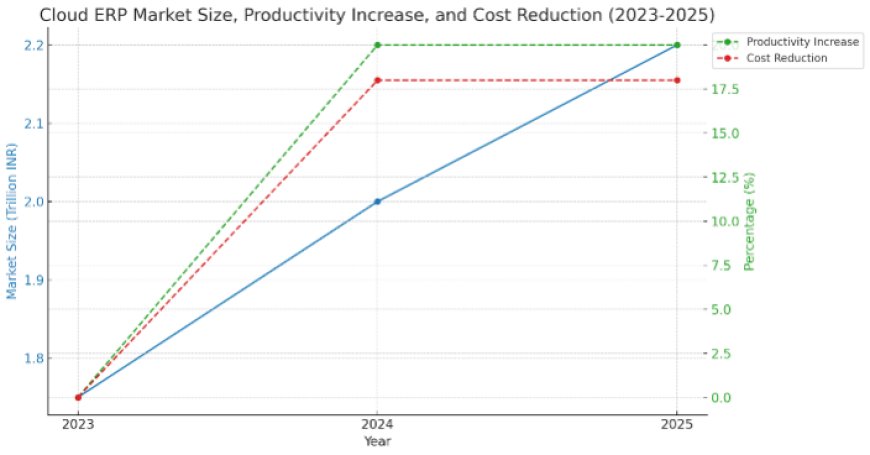
According to Statista, the global Cloud ERP market size is expected to surpass ₹2.2 trillion by 2025, growing at a compound annual growth rate (CAGR) of 13%. Gartner also reports that 70% of businesses using Cloud ERP systems have seen an improvement in operational efficiency and reduced time spent on manual tasks. Furthermore, businesses that have adopted Cloud ERP solutions have experienced a 20% increase in productivity and an 18% cost reduction in their overall operations. These metrics highlight the significant benefits of transitioning to Cloud ERP.
Spotify, a global music streaming giant, has leveraged Cloud ERP to improve its operational flexibility. The company uses cloud-based solutions to manage everything from user data to licensing agreements and payment processing.
With Cloud ERP, Spotify has enhanced its ability to scale operations, integrate new features, and respond quickly to market demands. The flexibility provided by Cloud ERP has been instrumental in helping Spotify maintain its position as a leader in the competitive streaming industry.
What is Cloud ERP?
Cloud ERP refers to an Enterprise Resource Planning system that is hosted on the cloud, rather than on physical, on-premise servers. This means that businesses can access ERP software and data over the internet from anywhere, at any time. With Cloud ERP, companies can manage all aspects of their business, such as accounting, HR, inventory, supply chain, customer relationship management (CRM), and more, in one unified system.
Unlike traditional ERP systems, Cloud ERP eliminates the need for costly hardware and maintenance. This reduces IT overheads and allows businesses to scale operations quickly. The cloud-based nature of the system also ensures that businesses are always working with the most up-to-date software and security protocols, without needing to manually install updates.
How Cloud ERP Enhances Business Flexibility

1. Scalability and Growth
One of the primary ways Cloud ERP enhances flexibility is by offering unparalleled scalability. Traditional ERP systems require significant investment in infrastructure and resources to scale, making it a time-consuming and costly process. However, with Cloud ERP, scaling up or down is as simple as upgrading your subscription or adding new features.
For example, a rapidly growing e-commerce business can easily increase its user capacity and integrate new functionalities, such as payment gateways or customer support tools, without the need for complex infrastructure changes. This allows businesses to be highly adaptable and responsive to customer demands, without worrying about resource limitations.
2. Remote Access and Collaboration
In a traditional ERP setup, employees are often bound to a specific location or device to access important business data. Cloud ERP removes this barrier, enabling businesses to access their system from anywhere with an internet connection. This is especially crucial in today’s remote work environment, where employees need to collaborate across different locations.
3. Real-Time Data and Insights
The ability to access real-time data is a game-changer for business flexibility. Cloud ERP provides businesses with up-to-date information on everything from inventory levels to financial reports, enabling quicker and more accurate decision-making. Real-time data allows businesses to monitor performance, identify trends, and respond to issues immediately.
4. Cost Efficiency and Lower IT Overhead
A major factor that enhances business flexibility is the cost efficiency of Cloud ERP. Traditional ERP systems require significant investment in hardware, software licenses, and IT support, while cloud-based solutions have a more predictable, subscription-based cost structure. As a result, businesses can save on IT infrastructure and maintenance costs and reallocate those funds towards growth initiatives.
5. Improved Customer Experience
By improving internal processes such as order fulfillment, inventory management, and customer relationship management, Cloud ERP enables businesses to deliver a better customer experience. The system integrates all business functions, providing a holistic view of customer interactions and needs, which ultimately leads to faster responses, personalized services, and stronger customer relationships.
Cloud ERP is a vital tool for businesses looking to enhance flexibility, streamline operations, and foster growth. By providing real-time data, scalable solutions, and remote access, Cloud ERP allows businesses to respond quickly to changing market demands and remain competitive in an ever-evolving landscape. Whether it’s for improving collaboration, optimizing processes, or cutting costs, Cloud ERP offers a flexible, efficient solution for businesses of all sizes.
If you’re ready to take your business to the next level, consider implementing a Cloud ERP solution today!