
Penetration Testing Services for IoT Ensuring Device Security
Secure your IoT devices from unseen threats. identify vulnerabilities, protect data, and ensure resilience with expert penetration testing.

As a cybersecurity professional specializing in IoT penetration testing, I’ve seen how the fast growth of connected devices has transformed how we live and work. The Internet of Things (IoT) is changing industries and introducing new conveniences, from smart homes and healthcare devices to industrial automation systems. But with this technological development comes an equally significant challenge: security. Every device added to a network becomes a potential entry point for malicious actors, making robust security measures not just an option but a necessity. My role is to step into the shoes of possible attackers, identify vulnerabilities, and fortify these devices against real-world threats, ensuring they remain resilient in the face of evolving cyber risks.
Engaging in penetration testing for IoT devices is more than just a technical exercise it's a mission to safeguard the trust users place in these technologies. When I approach a device, I think not only about its immediate functionality but also about the broader ecosystem it interacts with. A single compromised sensor in a smart factory, for example, can cascade into a major system failure. By emulating attacks and rigorously testing defenses, I aim to uncover weaknesses that could jeopardize safety, privacy, and operational continuity. For me, this process is about more than finding flaws; it’s about building a safer digital future where innovation thrives without compromising security.
What Is IoT Penetration Testing?
IoT penetration testing involves simulating real-world cyberattacks to identify vulnerabilities in IoT devices, their communication protocols, and the supporting infrastructure. This proactive approach helps organizations understand potential weaknesses and implement robust security measures to safeguard their IoT ecosystem.
Penetration testing for IoT typically includes:
-
Testing the hardware of devices for physical vulnerabilities.
-
Analyzing the firmware and software for backdoors and insecure configurations.
-
Evaluating communication protocols (e.g., Wi-Fi, Bluetooth, Zigbee) for encryption weaknesses or susceptibility to interception.
-
Assessing cloud integrations, APIs, and mobile apps associated with IoT devices.
-
Reviewing user authentication and data protection mechanisms.
Why Is IoT Security Crucial?
IoT devices are often designed with convenience in mind, leaving security as an afterthought. This negligence can lead to significant vulnerabilities, such as:
-
Data Breaches: IoT devices collect sensitive user data, making them a prime target for hackers.
-
Botnet Attacks: Insecure IoT devices can be hijacked to form botnets, as seen in the Mirai botnet attack.
-
Operational Disruptions: In industries relying on IoT, attacks can halt operations, causing financial losses and reputational damage.
-
Safety Risks: Vulnerabilities in IoT devices in healthcare, automotive, and critical infrastructure can endanger human lives.
Addressing these risks requires rigorous security testing to ensure devices are resilient against cyber threats.
Challenges in IoT Penetration Testing
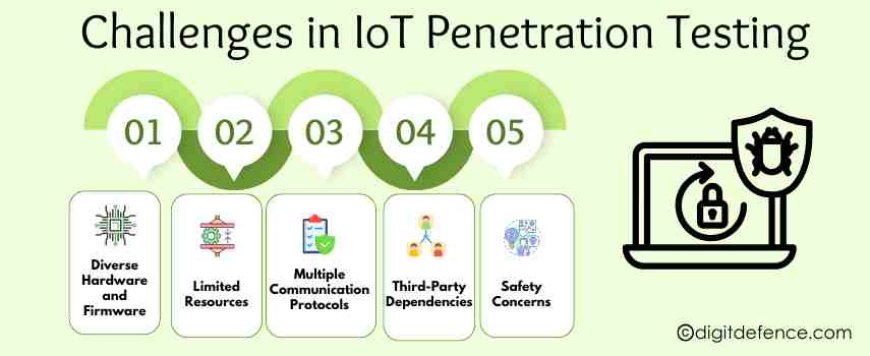
IoT penetration testing is more complex than traditional IT security assessments due to the following challenges:
-
Diverse Hardware and Firmware:
-
IoT devices come in varied forms, each with unique hardware and firmware specifications. Testing must account for these differences.
-
Limited Resources:
-
Many IoT devices have constrained processing power and memory, making it difficult to implement robust security features.
-
Multiple Communication Protocols:
-
IoT devices use diverse communication protocols, each with its own vulnerabilities. Penetration testing must cover all relevant protocols.
-
Third-Party Dependencies:
-
Many IoT ecosystems rely on third-party APIs, cloud services, and mobile apps. Ensuring end-to-end security is critical but challenging.
-
Safety Concerns:
-
Testing IoT devices in healthcare or industrial environments requires caution to avoid disruptions or safety hazards.
Key Methodologies in IoT Penetration Testing
IoT penetration testing involves a combination of methodologies tailored to the unique aspects of IoT devices:
1. Hardware Testing
-
Objective: Identify physical vulnerabilities, such as unsecured ports, tamper-evident features, or hardware backdoors.
-
Tools: Oscilloscopes, JTAG debugging tools, RFID analyzers.
2. Firmware Analysis
-
Objective: Detect hardcoded credentials, insecure configurations, or outdated components.
-
Tools: Firmware emulators, static analysis tools, binary analysis frameworks.
3. Network Protocol Testing
-
Objective: Assess vulnerabilities in communication protocols, such as unencrypted transmissions or weak authentication mechanisms.
-
Tools: Wireshark, Burp Suite, and custom protocol fuzzers.
4. Mobile and API Testing
-
Objective: Ensure secure communication between mobile apps, APIs, and IoT devices.
-
Tools: Postman, OWASP ZAP, API fuzzing tools.
5. Cloud Security Testing
-
Objective: Evaluate the security of cloud services and integrations supporting IoT devices.
-
Tools: AWS Inspector, cloud configuration analyzers, penetration testing platforms.
6. User Authentication Testing
-
Objective: Assess authentication mechanisms for susceptibility to brute force, replay attacks, or bypass techniques.
-
Tools: Hydra, John the Ripper, custom scripts.
Benefits of IoT Penetration Testing
Conducting penetration testing for IoT devices delivers several critical benefits:
-
Proactive Risk mitigation:
-
Identifies vulnerabilities before malicious actors can exploit them.
-
Regulatory Compliance:
-
Helps organizations comply with security standards like GDPR, HIPAA, or ISO 27001.
-
Enhanced Customer Trust:
-
Demonstrates a commitment to security, strengthening brand reputation.
-
Operational Continuity:
-
Reduces the risk of disruptions caused by cyberattacks on IoT devices.
-
Improved Product Quality:
-
Enhances the overall reliability and security of IoT devices, resulting in better user experiences.
Best Practices for IoT Security
Organizations can adopt the following best practices alongside penetration testing to bolster IoT security:
-
Secure Development Lifecycle: Integrate security into every stage of IoT product development.
-
Regular Updates: Ensure timely updates for firmware, software, and security patches.
-
Encryption: Use strong encryption for data transmission and storage.
-
Access Control: Implement robust authentication mechanisms and limit access to critical systems.
-
Incident Response Plan: Establish a clear plan to respond to IoT security incidents effectively.
Choosing the Right Penetration Testing Service
When selecting a penetration testing service for IoT, consider the following factors:
-
Expertise: Ensure the service provider has proven experience in IoT security.
-
Tools and Methodologies: Verify that the testing approach covers hardware, software, and network vulnerabilities.
-
Certifications: Look for certifications like OSCP, CEH, or CISSP among the testing team.
-
Compliance Knowledge: Ensure the provider understands relevant regulatory requirements.
-
Comprehensive Reporting: Opt for services that offer detailed reports with actionable recommendations.
Case Study 1: BMW’s ConnectedDrive System Vulnerabilities
Overview:
BMW’s ConnectedDrive system, which allows remote control of vehicle functions via mobile apps, was found to have critical vulnerabilities. These included weaknesses in the password reset process and improper validation of Vehicle Identification Numbers (VINs).
Implementation:
Cyber security researchers conducted penetration testing on the system, identifying flaws in authentication mechanisms and data exchange protocols. They simulated potential attacks to evaluate the risks.
Outcome:
BMW addressed the vulnerabilities by releasing security updates and enhancing system authentication. These measures improved the overall security of the ConnectedDrive platform, ensuring user safety and data protection.
Case Study 2: Security Flaws in Smart Security Cameras
Overview:
An IoT provider serving clients like Schneider Electric, Phillips, and Lenovo identified potential security issues in their smart security cameras and accompanying mobile apps.
Implementation:
A cybersecurity firm performed penetration testing on the cameras and mobile applications, assessing hardware, firmware, and data exchange protocols. The testing revealed minor flaws in the device firmware and app design.
Outcome:
The company resolved the identified vulnerabilities and implemented security enhancements. These improvements ensured the safety of sensitive user data and strengthened the devices' overall security.
The growing adoption of IoT devices necessitates a proactive approach to security. Penetration testing services for IoT provide an essential layer of defense, helping organizations uncover vulnerabilities and strengthen their devices against evolving cyber threats. By investing in comprehensive IoT security testing, businesses can protect their customers, assets, and reputations while driving innovation in a secure and trustworthy ecosystem.